The reconstruction results indicate that the global climate during the Cambrian Explosion experienced a three-stage change process from greenhouse to super greenhouse and back to greenhouse: between 553 million and 529 million years ago, atmospheric CO2 concentration rapidly increased from about 6 times modern levels to about 14 times, and the Earth entered an extreme super greenhouse period;
; After 529 million years ago, the concentration of CO2 continued to decline, dropping to about five times the modern level by 508 million years ago, and the climate returned to a greenhouse state (Figure 1). At the same time, the research team also conducted carbon strontium isotope coupling analysis, and the results showed that the changes in atmospheric carbon dioxide concentration were highly coupled with the evolution of strontium isotopes (87Sr/86Sr) in seawater during the same period: the stage of rapid increase in CO2 corresponded to a significant decrease in the strontium isotope ratio in seawater.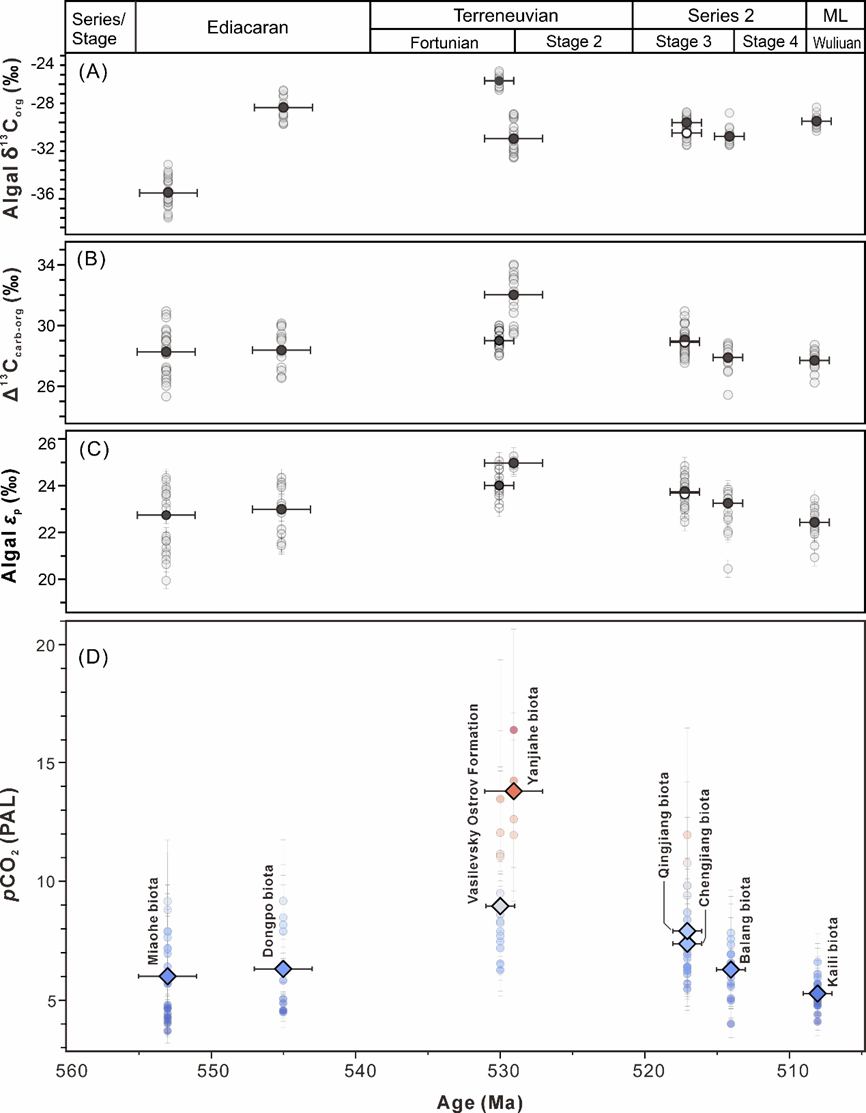
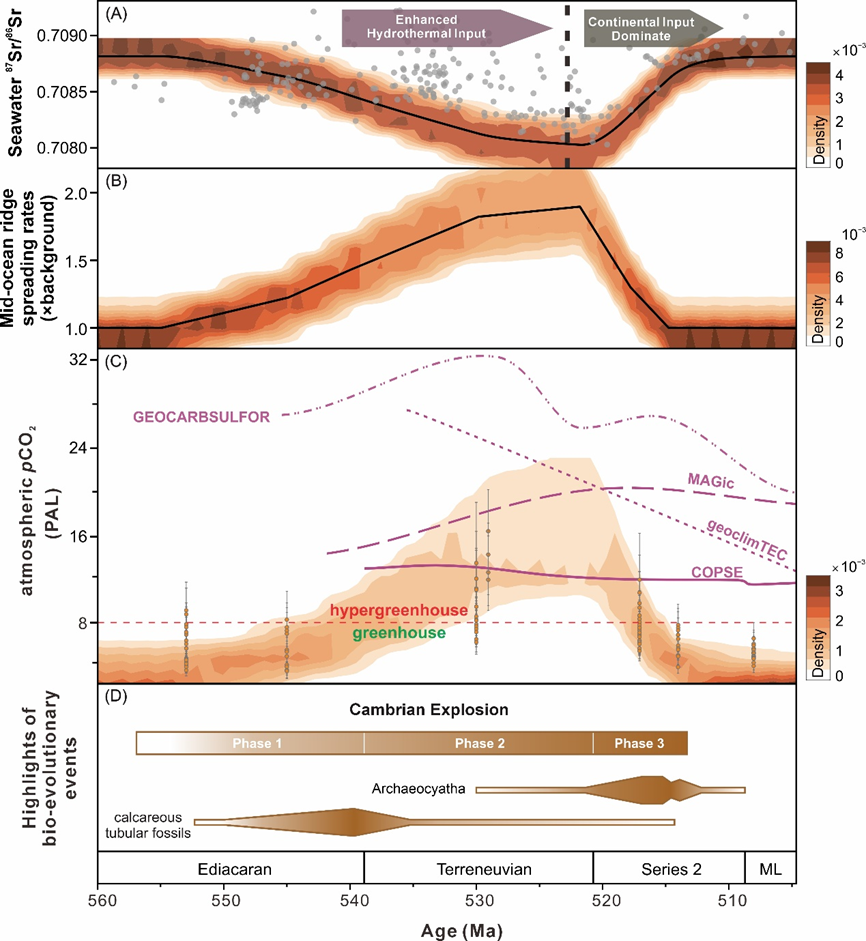
The remote regulation of surface systems by deep Earth processes has profoundly shaped the climatic conditions and rhythms of Cambrian life evolution. The high temperature during the super greenhouse stage can suppress vertical mixing and thermal circulation in the ocean, promote the expansion of hypoxic water bodies, and provide a unique ecological niche for early animal groups with low oxygen tolerance; Subsequently, the climate returned to a mild greenhouse period, and the saturation of seawater carbonate gradually increased, creating favorable conditions for the popularization of mineralized animal bones and the radiation evolution of shell bearing organisms.
This achievement is a paradigm for the in-depth interdisciplinary study of the co evolution of structure environment life, geochemistry, and paleontology. Using solid fossils as carriers to solve the problem of reconstructing ancient climate, the causal chain between tectonic activity, climate change, and life evolution is linked through the synergistic evolution law of carbon and strontium isotopes. Although there is still some uncertainty in the absolute value of reconstructed carbon dioxide concentration, this is the first time in academia that the atmospheric CO2 concentration and climate change framework of the entire Cambrian Explosion process have been fully outlined based on physical geological records. It opens up a new research perspective for understanding how deep processes and surface systems of the Earth jointly write a magnificent chapter in the evolution of life.
Article information: Chang, C., Zhao, M., Ju, P. et al. Algal δ13C reveals climate changes during the Cambrian Explosion. Nat Commun (2026). https://doi.org/10.1038/s41467-026-74516-9.

 No. 229, Taibai North Road, Xi'an, Shaanxi Province
 710069
 029-88302202
 029-88302202
 geo_office@nwu.edu.cn
 English


 登录
登录


 Home
Home