Article link: https://doi.org/10.1016/j.jrmge.2026.05.014.
I. Paper Introduction
Natural aeolian loess has characteristics such as loose structure, developed pores, and strong water sensitivity. Against the backdrop of global climate change and increasing extreme rainfall events, rainfall infiltration, dry wet cycles, and engineering disturbances continue to increase. The instability of the metastable structure of loess leads to collapsible deformation, which in turn triggers uneven settlement of the foundation, slope instability, and geological disasters, becoming increasingly prominent.
. The essence of loess subsidence disaster is the dynamic response of multi-scale pore network instability caused by water infiltration into loess under climate change and engineering disturbance. Therefore, understanding the multi-scale pore network structure is the key to identifying the root causes of major engineering disasters in loess areas, revealing the formation and evolution mechanism of metastable structures in loess, and elucidating the inherent relationship between pore connectivity, water infiltration, and collapsible deformation. This is an important scientific issue for identifying, assessing, and preventing major engineering geological disasters in loess areas. However, existing research is mostly limited to a single dimension of static structure loess pores and collapsibility. There is still a lack of systematic understanding on how multi-scale pore structure, wind formed loess metastable structure formation, and water infiltration synergistically drive collapsibility evolution.Based on the above issues, the team led by Xie Wanli from Northwest University, with the support of funding projects such as the National Natural Science Foundation of China (42372320), the Shaanxi Provincial Natural Science Basic Research Program Youth Project (2025JC-YBQN-401), and the Xi'an Science and Technology Plan Project (24LLRHZDZ0019), took the typical Malan loess in Yan'an, Shaanxi Province as the research object, and used X-ray computed tomography (XRCT) and scanning electron microscopy (SEM) micro testing methods to systematically analyze the geometric morphology, topological connectivity, and spatial distribution characteristics of multi-scale pores in aeolian loess. Research has revealed that the multi-scale pore network in loess jointly controls the migration of water. A large number of small pores control local water storage and slow infiltration through capillary suction, while medium pores connect the main seepage path and promote water diffusion to the surrounding area. The advantageous seepage channels formed by connecting large pores can accelerate water migration. As water continuously diffuses along the multi-scale pore network, the interparticle bonding gradually weakens and the particle skeleton rearranges, leading to a decrease in soil strength and sudden collapse. Through methods such as 3D pore network reconstruction, absolute permeability numerical simulation based on Stokes flow, and discrete element method (DEM) sedimentation simulation, the team has discovered for the first time that loess collapsibility is not only controlled by pore size and quantity, but also by the topological organization of the pore network. The main pore spaces and dominant infiltration channels inside loess are controlled by large pores with strong connectivity. Among them, vertical through pores with an equivalent diameter greater than 300 μ m can significantly improve the permeability of soil; A highly connected pore network characterized by negative Euler numbers is beneficial for forming rapid infiltration paths, thereby increasing the likelihood of collapsible deformation under saturation conditions. On this basis, an innovative research framework for "water induced instability of loess" was constructed, which includes "pore morphology topological connectivity seepage response collapsibility behavior". Further verification through DEM sedimentary numerical simulation shows that particle deposition, contact, and local rearrangement processes under gravity can form a vertically dominant pore network structure, revealing that shallow loess typically has higher pore connectivity, stronger infiltration capacity, and more significant collapsibility than deep compacted loess. This study reveals the key control mechanisms for the formation of metastable structures and the evolution of water induced subsidence in aeolian loess from the perspective of multi-scale pore structure. It can provide theoretical basis and technical reference for the prevention and control of major engineering disasters in loess areas, and is of great significance for improving the disaster prevention and reduction capabilities of major engineering projects in loess areas and serving the high-quality development of the Yellow River Basin. The first author of the paper is Dr. Yang Hui from Northwestern University, and the corresponding author is Professor Xie Wanli. Collaborators include Dr. Liu Qiqi and Dr. Li Xinyu from Northwestern University. The research was completed by relying on the National Key Laboratory of Continental Evolution and Early Life of Northwest University, the Department of Geology of Northwest University, the Joint Laboratory for the Prevention and Control of the Belt and Road Special Geotechnical Dynamic Disasters in Shaanxi, and the Xi'an Key Laboratory for the Prevention and Control of Loess Dynamic Disasters and Low Carbon Ecological Restoration.
2. Main conclusions of the paper
1. Multiscale pore structure: a small number of large pores control the main pore space
Research has shown that aeolian loess has a significant multi-scale, heterogeneous pore system.
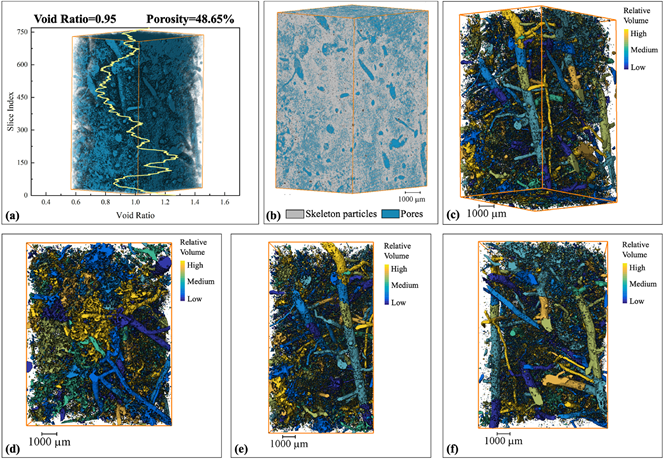
. Although small pores dominate in terms of quantity and are mostly distributed in isolation, in terms of volume distribution, large pores contribute the main CT recognizable pore space. Although their number is relatively small, they account for 76.6% of the total pore volume and are key structural units that affect the permeability and collapsibility sensitivity of loess. The 3D reconstruction results show that the natural loess pores exhibit an open network morphology of staggered connectivity and localized concentration. Large tubular pores often develop vertically and can preferentially form dominant infiltration channels under rainfall or immersion conditions, making it easier for water to migrate deeper along connected large pores, thus providing an important structural foundation for the deformation and instability of loess under infiltration conditions.(a) Pore ratio distribution and surface porosity analysis, (b) 3D visualization of skeleton particles and pores, (c) 3D pore structure distribution based on relative volume, (d) 3D pore structure distribution in XY plane, (e) XZ plane, and (f) YZ plane.
.
2. Pore Topology: Connected pores determine water migration and collapse triggering
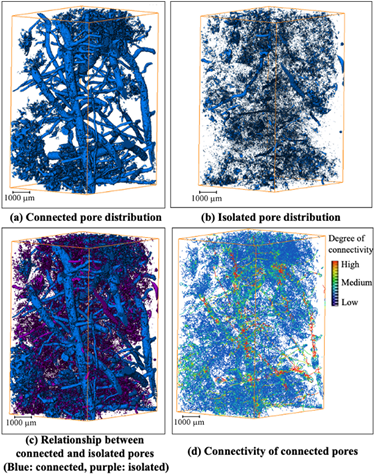
Topological parameters such as connectivity, Euler number, fractal dimension, tortuosity, and coordination number are introduced to quantitatively analyze the characteristics and connectivity of the 3D pore network. The results showed that the connectivity rate of the loess pore structure in the study area reached 81%, with a fractal dimension of 2.715, indicating complex pore boundaries, rough surfaces, and well-developed connected networks. Among them, there are a large number of interconnected channels and circular networks inside the connected pores, which can significantly promote rapid water infiltration; On the contrary, isolated pores reflect a large number of closed or weakly connected states, and contribute less to water migration. In other words, what truly controls the triggering of loess subsidence is not whether there are many pores, but whether the pores are connected and vertically connected.
3. Permeability simulation: Vertically connected large pores are the main dominant seepage channels
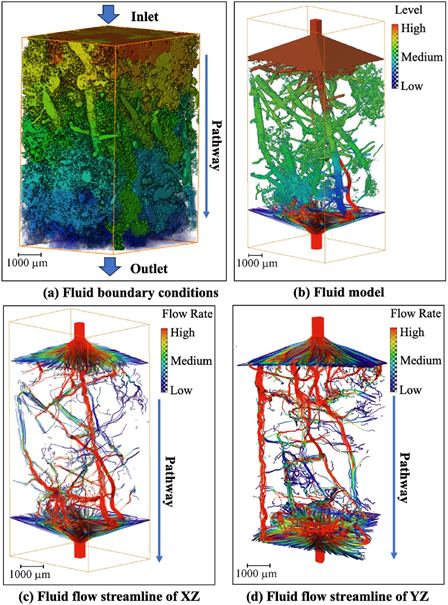
Absolute permeability simulation based on image reconstruction further verifies the controlling effect of pore topology on hydraulic behavior. The simulation results show that vertically developed, larger scale, and highly connected pores have higher flow velocity and stronger permeability, while horizontally oriented small pores and weakly connected pores exhibit lower permeability. Research has shown that vertical through pores with equivalent diameters greater than 300 μ m constitute the main seepage channels in loess; Meanwhile, pore networks with moderate tortuosity and high coordination numbers are more likely to enhance water migration ability. This discovery provides scientific support for the rapid strength attenuation and structural instability of loess under water conditions at the pore scale.
4. Sedimentary Simulation: Wind blown Sedimentation Shapes a Vertically Preferred Pore Network
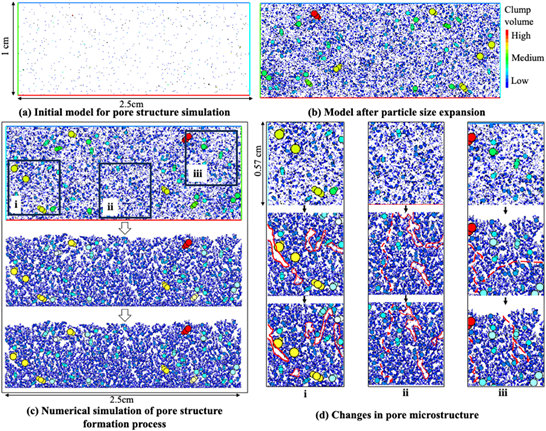
Using discrete element sedimentary simulation of wind blown loess, the formation and evolution process of vertically connected pores in loess are truly revealed. The results indicate that under the action of gravity, loess particles are rearranged, gradually compacted, and form connected channels along or near the vertical direction. This process indicates that the metastable structure of loess is not caused by a single factor in the later stage, but rather a multi-scale structural system formed under the combined action of aeolian sedimentation, gravity rearrangement, and later compaction. As the burial depth increases, gravity compaction strengthens, the particle skeleton tends to stabilize, and the structural anisotropy weakens. This also provides a mechanism explanation for the stronger collapsibility of shallow loess compared to deep compacted loess.
III. Author Introduction



 No. 229, Taibai North Road, Xi'an, Shaanxi Province
 710069
 029-88302202
 029-88302202
 geo_office@nwu.edu.cn
 English


 登录
登录


 Home
Home