What exactly happened from "greenhouse Earth" to "ice house Earth"? The Cenozoic era is a critical period for the Earth's climate to transition from a warm "greenhouse" to a cold "ice house". About 60 million years ago, crocodiles lived in the Arctic waters and palm trees grew on the Antarctic continent; Today, the poles are covered by thick ice sheets, and the global average temperature has decreased by more than ten degrees Celsius compared to that time. For a long time, the scientific community has generally believed that the uplift of large mountain ranges such as the Qinghai Tibet Plateau has promoted the weathering of continental silicates, consuming a large amount of atmospheric carbon dioxide (CO ₂), thereby driving sustained global cooling. However, this classic theory always faces an unexplainable problem: if weathering continues to intensify, CO ₂ in the atmosphere should be rapidly consumed within millions of years, and the Earth would have already entered an extreme freezing state similar to a "snowball Earth". Why isn't that the case? The key to answering this question is to accurately reconstruct the evolutionary process of the Cenozoic carbon silicon cycle.
Cracking the ocean lithium cycle and climate cooling mechanism
Quantitatively restoring ancient carbon cycles is not an easy task.
. Continental weathering is jointly controlled by multiple factors such as tectonic uplift, climate change, and erosion rate, while oceanic weathering, as an important process for releasing CO ₂ into the atmosphere, lacks reliable constraints on its evolutionary history for a long time. Traditional geochemical tracers such as strontium (Sr) and osmium (Os) can reflect the enhancement of continental erosion, but they are easily affected by the weathering of carbonate rocks and sulfides, making it difficult to accurately record the process of silicate weathering. In contrast, lithium has natural advantages. On the one hand, lithium is almost entirely present in silicate minerals and is not affected by carbonate rock weathering, making it an ideal tracer for silicate weathering; On the other hand, during the weathering process, the light isotope ⁶ Li preferentially enters newly generated clay minerals, while the heavy isotope ⁷ Li enters rivers and eventually flows into the ocean. Therefore, the lithium isotope composition of seawater can sensitively record the weathering process of continents. Meanwhile, the lithium concentration and isotopic composition in seawater have been well recovered through geological records, providing an important foundation for reconstructing the ancient oceanic lithium cycle. However, there are still many controversies about the Cenozoic lithium cycle: whether continental weathering has been enhanced? How did lithium isotopes in rivers evolve? Is ocean weathering enhanced or weakened? Different studies have even reached completely opposite conclusions. The root of the problem lies in the fact that previous studies often only used one type of record, lithium concentration or lithium isotopes, and assumed in advance the changing trends of certain geological processes. Therefore, different models can fit existing data, but it is difficult to obtain a unique solution.In response to this issue, the research team has for the first time integrated two sets of independent records of seawater lithium concentration and δ ⁷ Li over the past 60 million years, established a coupled mass isotope balance model, and combined it with Monte Carlo random simulation to conduct a large number of random samples within a reasonable parameter range, without pre-set any trend of weathering or anti weathering flux changes, but allowing observation data to constrain the evolution path of the model on its own.
. In addition, multiple sensitivity tests were conducted, including changing the lithium isotope fractionation coefficient, fixing the hydrothermal input, and adjusting the smoothing parameters. The results showed that the model inversion was stable and reliable.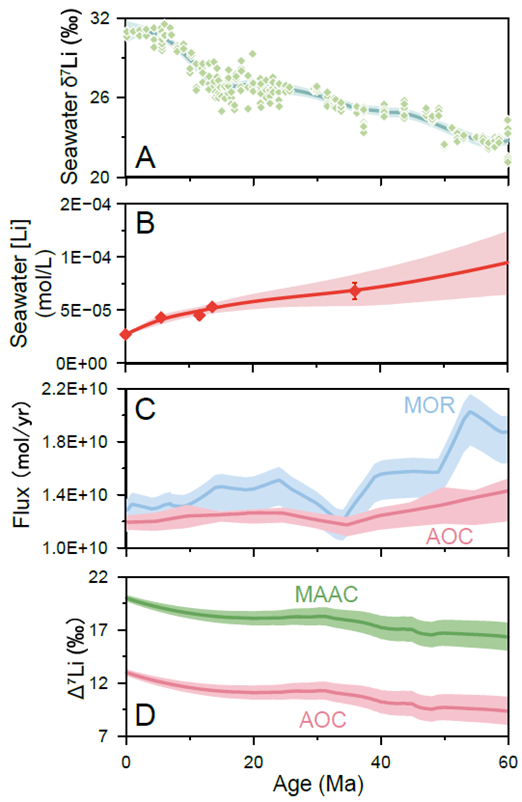
The evolution of the Cenozoic carbon silicon cycle
Firstly, the weathering flux of continental silicates only increased slightly.
The model shows that the weathering flux of the Cenozoic continent only increased by about 50%, and mainly occurred before the transition period from the Eocene to the Oligocene, which was basically synchronized with the rapid decline of atmospheric CO ₂. This means that although continental weathering has intensified, it is far from reaching a level sufficient to rapidly deplete atmospheric CO ₂, thus explaining the long-standing 'ice house paradox'. Secondly, the consistency of weathering continues to decline.
Research has found that the δ ⁷ Li in rivers has increased by about 13 ‰, and the weathering consistency has decreased from 0.52 to 0.24, indicating that more and more lithium is fixed in secondary clay minerals, while the proportion of truly released into rivers continues to decrease.
. In other words, although tectonic uplift promotes erosion, the efficiency of chemical weathering significantly decreases with global cooling. Further calculations by the model indicate that the erosion rate of the Cenozoic actually increased by about 3.3 times, which is consistent with global sedimentary records. Thirdly, the anti weathering of the ocean has significantly weakened. The model shows that the anti weathering intensity of the ocean has decreased by about 60%. This result indicates that while continental weathering is intensifying, there has been a significant reorganization of the oceanic silicon cycle. With the rapid proliferation of diatoms, a large amount of dissolved silicon is efficiently utilized by organisms and circulated in the upper layer of the ocean, reducing the amount of silicon entering the seabed to form clay minerals, thereby weakening anti weathering and reducing the ocean's ability to release CO ₂ into the atmosphere.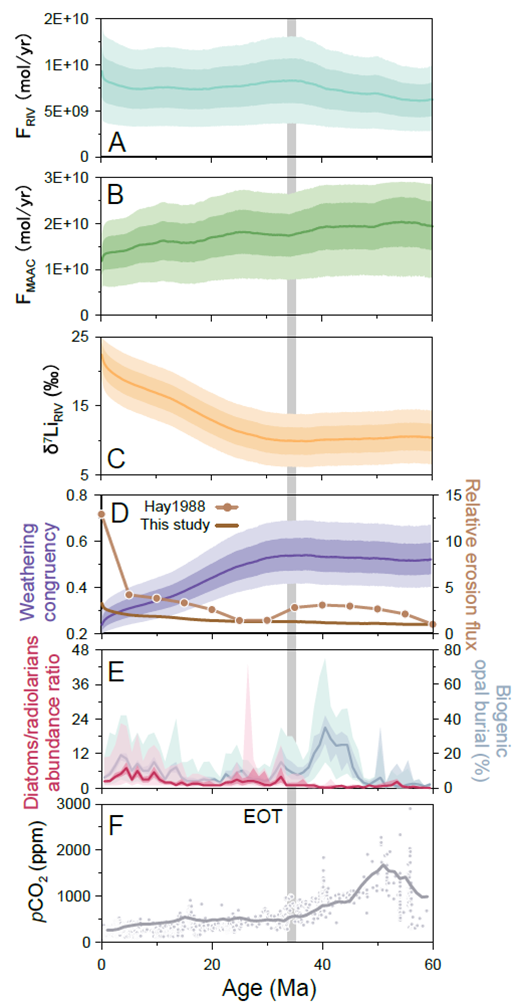
New mechanism: continental weathering and ocean anti weathering jointly drive global cooling
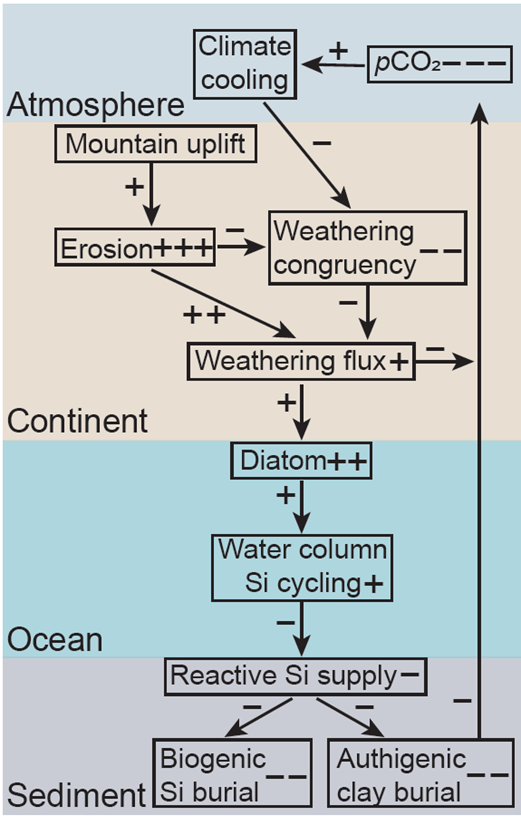
Based on the comprehensive model results, the research team proposed a new mechanism for the synergistic evolution of the new generation carbon silicon cycle. Before the Eocene epoch, under high temperature and high CO ₂ conditions, the weathering efficiency of the continent was relatively high, and the anti weathering of the ocean was also active, maintaining a dynamic balance between the two. About 34 million years ago, the Earth entered the Eocene Oligocene climate transition period. With the global cooling, the rate of chemical weathering is suppressed, and the consistency of weathering continues to decline; At the same time, diatoms rapidly evolve and reshape the oceanic silicon cycle, leading to a continuous weakening of ocean weathering. After entering the Oligocene, although tectonic uplift continued to promote erosion, the net weathering flux of the continent only slightly increased due to a decrease in weathering efficiency of over 50%; At the same time, the ocean's anti weathering continues to weaken, resulting in a continuous decrease in CO ₂ release. The combined effect of the two ultimately drove the long-term climate cooling of the Cenozoic era.
Adding a key link to the classical theory
The classical theory suggests that "tectonic uplift → erosion enhancement → weathering enhancement → CO ₂ decline → global cooling". This study further reveals that this process is actually regulated by multiple negative feedback mechanisms. Although tectonic uplift promotes erosion, global cooling leads to a continuous decrease in weathering consistency, resulting in only a limited increase in continental weathering flux; At the same time, the reorganization of the oceanic silicon cycle weakens the anti weathering effect and reduces the release of CO ₂. The strengthening of continental weathering and the weakening of oceanic anti weathering jointly drive the sustained cooling of the Cenozoic era, while the decrease in weathering consistency effectively avoids the rapid depletion of CO ₂ and provides an important self-regulation mechanism for the Earth's climate system, keeping the Earth relatively stable on a scale of tens of millions of years without sliding towards extreme freezing states. The first author of the paper is Zhang Pan, a postdoctoral fellow in the Department of Geology at Northwestern University, and the corresponding author is Professor Huang Kangjun from the same department. The research was supported by the National Natural Science Foundation of China (42402115, 42373061) and the General Project of China Postdoctoral Science Foundation (2024M752617). Zhang Pan also received funding from the China Scholarship Council.
Paper information: Zhang, P., Huang, K.-J.*, 2026. Coupled continental and reverse weathering influence on Cenozoic cooling revealed by the marine lithium cycle. Geology.
https://doi.org/10.1130/G54403.1

 No. 229, Taibai North Road, Xi'an, Shaanxi Province
 710069
 029-88302202
 029-88302202
 geo_office@nwu.edu.cn
 English


 登录
登录


 Home
Home