To solve this problem, a joint research team composed of Northwest University, Jilin University, the Chinese Academy of Sciences Nanjing Institute of Geology and Palaeontology, the Chinese Academy of Sciences Xinjiang Institute of Ecology and Geography, the Open University of the United Kingdom, Toyama University of Japan and other units found a well preserved late Cenomanian shallow sea fossil biota at the bottom of the Puga Formation in Asuo Township, Nima County, Xizang, named Puga Biota; And systematic biostratigraphy, zircon U-Pb geochronology, strontium isotope stratigraphy, and bivalve shell carbon oxygen isotope geochemistry studies were conducted on this biota, providing precise age constraints and paleontological evidence for the initial uplift of the central Qinghai Tibet Plateau. This achievement was successively published in the international geological journals Continent and Life Evolution and Geophysical Research Letters in 2026.
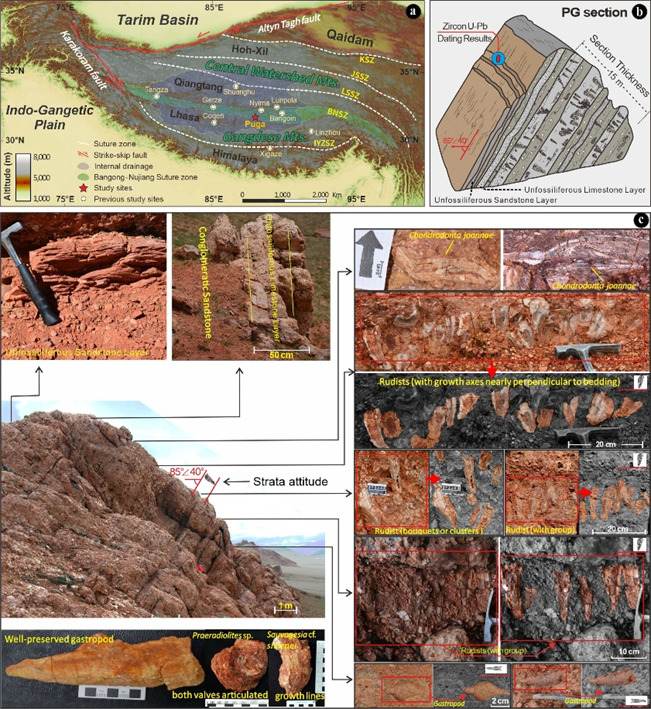
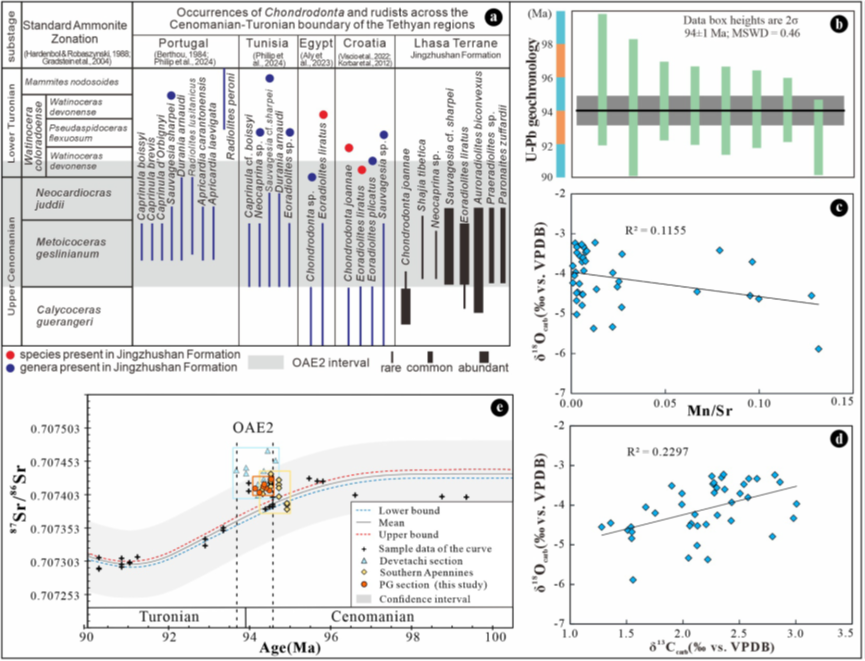
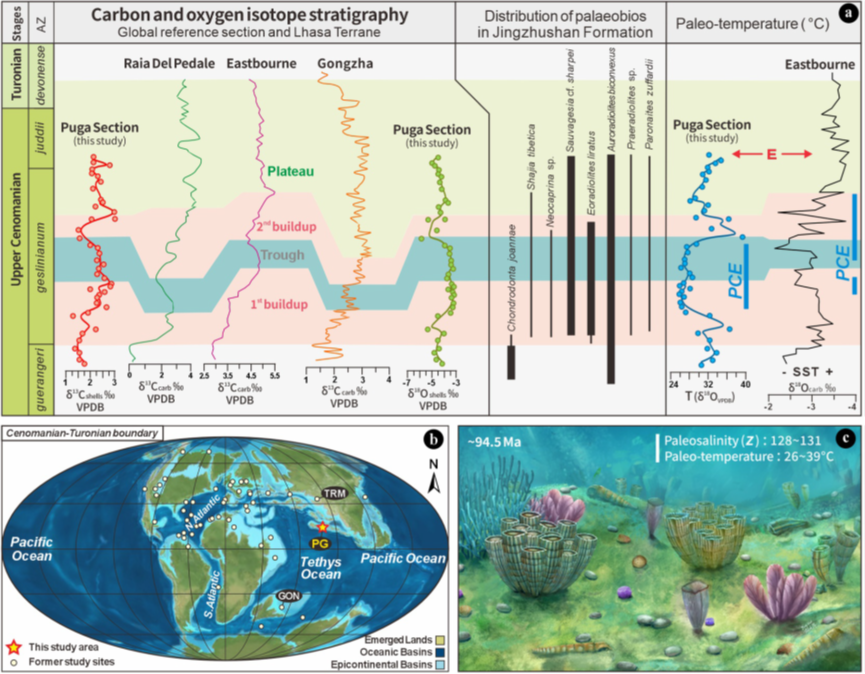
The research team discovered a shallow sea carbonate platform facies benthic fossil assemblage dominated by bivalves (bivalves) in the red gravelly limestone and fine conglomerate extending laterally for more than 300 meters at the bottom of the Jingzhushan Formation in Puga section, including Paronaites zuffardi、Eoradiolites liratus、Sauvagesia cf. sharpei、Chondrodonta joannae、Neoptyxis olisiponensis Waiting for typical late Senonian elements. Among them, fossilized clams often maintain an upright growth state, indicating burial in situ. This combination can be compared with the standard ammonite belt and biological events of the Late Senonian period in Western Tethys. The detrital zircon U-Pb dating obtained the youngest peak age of 94 ± 1 Ma, limiting the maximum sedimentary age of the mineralized layer to the Late Senonian period. The ⁸⁷ Sr/⁸⁶ Sr values of the dense outer shell layer of Auroradialite are 0.707407-0.7426, which are consistent with the contemporaneous records of the Western Tethys carbonate platform. 41 sets of data were obtained by analyzing the δ 13C and δ 18O values of the fixed clam shell. The δ 13C values (1.28 ‰ -3.01 ‰) recorded the OAE2 initiation to the early platform stage; The reconstructed paleotemperature of δ 18O shows significant fluctuations: approximately 31 ℃ before the OAE2 period, rising to 37 ℃ during the First build period, dropping to 26 ℃ during the Plenus cold event and fluctuating between 26-29 ℃, reaching a peak of 39 ℃ during the Second build period, and stabilizing at 31-35 ℃ during the Plateau stage; The ancient salinity value (Z=128-131) is stable, indicating a normal marine environment.
Paper details:
Wang, M.*, Rao, X.*, Palin, R. M., Skelton, P. W., Xiao, W., Zhang, Y., Hao, B., Song, D., Wang, B., Guo, Y., Yu, T., Liang, K., & Schlagintweit, F. (2026). A shallow-marine ecosystem before initial Tibetan Plateau uplift. Geophysical Research Letters, 53, e2026GL123945. https://doi.org/10.1029/2026GL123945
Rao, X.*, Li, Z., Skelton, P. W., Sano, S., Ye, K., & Wang, M.* (2026). Late Cenomanian radiolitid rudists from the Jingzhushan Formation of the northern Lhasa Terrane. Continent and Life Evolution. https://doi.org/10.55092/cle20260005

 1 Xuefu Avenue, Guodu Education Industrial Park, Chang'an District, Xi'an, Shaanxi Province
 710127
 029-88302202
 029-88302202
 geo_office@nwu.edu.cn
 English


 登录
登录


 Home
Home