Recently, the Early Life and Environment research team from Northwest University published a research paper titled "A reversed latitudinal ocean oxygen gradient in the Proterozoic Eon" in Nature Geoscience. The study analyzed the paleolatitudinal distribution of the I/Ca geochemical proxy over the past 2 billion years and discovered that during the Proterozoic Eon, marine oxygen content decreased from near the equator toward mid-to-high latitudes, with oxygen distribution dominated by Oxygenic Photosynthesis, following an "oxygen oasis" oxidation model. In contrast, during the Phanerozoic Eon, marine oxygen content increased from near the equator toward mid-to-high latitudes, with oxygen distribution dominated by seawater temperature and organic matter remineralization, following a latitude-controlled oxidation model similar to that of the modern ocean. The transition in marine oxidation models is related to atmospheric oxidation processes at the Proterozoic-Phanerozoic boundary, providing important paleoenvironmental context for studying the rapid radiation and evolution of marine life between 600 and 500 million years ago.
The research was conducted by an international team led by Professor Zhang Xingliang and Associate Professor He Ruliang from the Department of Geology at Northwest University. Other primary authors include Dr. Alexandre Pohl from the French National Centre for Scientific Research and Professor Zunli Lu from Syracuse University in the United States. Additionally, Associate Professor Chang Chao from Northwest University, Professor Jonathan Payne and Dr. Ashley Prow-Fleischer from Stanford University, Professor Andy Ridgwell from the University of California, Riverside, and Professor Shuhai Xiao from Virginia Tech also contributed to the study.
Paper link: https://www.nature.com/articles/s41561-025-01896-w
Marine oxygen content is a critical factor influencing the radiation and evolution of early life. The vast expanse of the ocean exhibits strong spatial variability in oxygen content. For example, oxygen distribution in the early Earth's ocean may have followed a productivity-dominated "oxygen oasis" model, whereas in the modern ocean, highly productive waters are more prone to hypoxia, resulting in a completely different spatial distribution pattern of oxygen.
The I/Ca proxy can record the latitudinal gradient of marine oxygen content.
The oxygen content in the upper layers of the modern ocean exhibits a significant latitudinal gradient, decreasing from mid-to-high latitudes toward the equator. This is due to factors such as temperature control on oxygen solubility and the frequent development of oxygen minimum zones (OMZs) at low-latitude continental margins. This latitudinal gradient in oxygen affects the redox processes of iodine. The concentration of oxidized iodate ions (IO₃⁻) in seawater also decreases from mid-to-high latitudes toward the equator, and the I/Ca ratio (a redox proxy) in shells of modern planktonic foraminifera shows a similar latitudinal gradient. Therefore, the I/Ca proxy can be used to reconstruct the latitudinal gradient of marine oxygen content during geological history.
Figure 1 Latitudinal gradients of oxygen content, iodate concentration, and foraminiferal shell I/Ca in the upper layers of the modern ocean.
Evolution of the latitudinal gradient in marine oxygen content over the past 2 billion years: Proterozoic vs. Phanerozoic
By compiling published I/Ca data from carbonate rocks and incorporating paleogeographic models, this study analyzed the latitudinal distribution patterns of oxygen content in the upper ocean over the past 2 billion years. During the Proterozoic, high I/Ca values predominantly occurred in low-latitude regions and decreased toward mid-to-high latitudes, exhibiting a latitudinal gradient opposite to that of the modern ocean. It was not until the Phanerozoic that the latitudinal gradient in seawater oxygen content shifted to the modern oceanic pattern, with carbonate I/Ca ratios decreasing from mid-to-high latitudes toward the equator. The transition in the latitudinal gradient of seawater oxygen content occurred at the boundary between the Proterozoic and Phanerozoic eons.
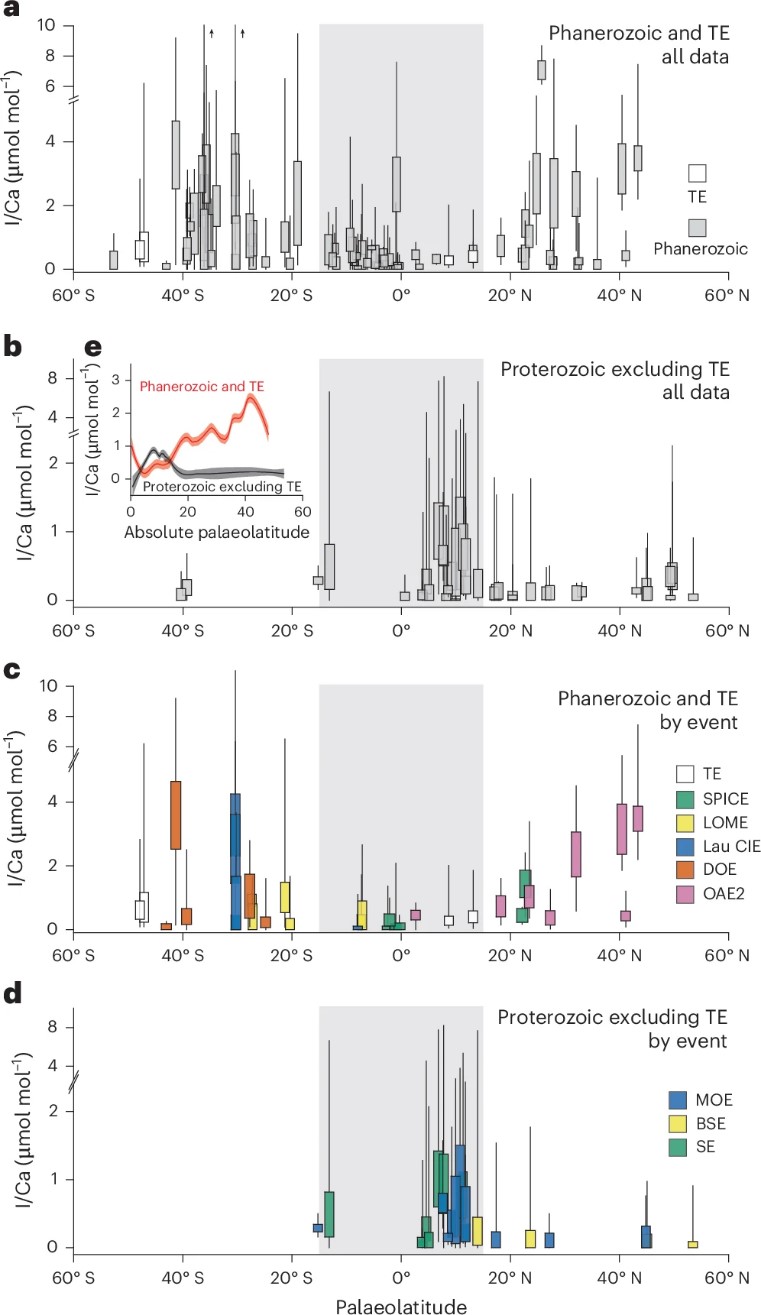
Figure 2 Paleolatitudinal distribution of bulk carbonate I/Ca ratios: a) Phanerozoic, b) Proterozoic, c) specific Phanerozoic geological events, d) specific Proterozoic geological events.
Data and model validation: From an "oxygen oasis" to a modern-like latitude-controlled marine oxidation model
Using the Earth system model cGENIE, the study simulated the spatial distribution of oxygen in the global upper ocean. Under high pO₂ conditions, the latitudinal gradient in oxygen solubility controlled by temperature and organic matter remineralization processes at low latitudes produced a Phanerozoic-like gradient with higher oxygen levels at mid-to-high latitudes. Under low pO₂ conditions, the controlling effects of temperature and organic matter remineralization diminished, and "oxygen oases" generated by oxygenic photosynthesis began to dominate oxygen distribution in the upper ocean, resulting in a Proterozoic-like gradient with higher oxygen levels at low latitudes. This indicates that at the Proterozoic-Phanerozoic boundary, the paleo-oceanic oxidation model began to shift from an "oxygen oasis" type to a modern-like latitude-controlled type.
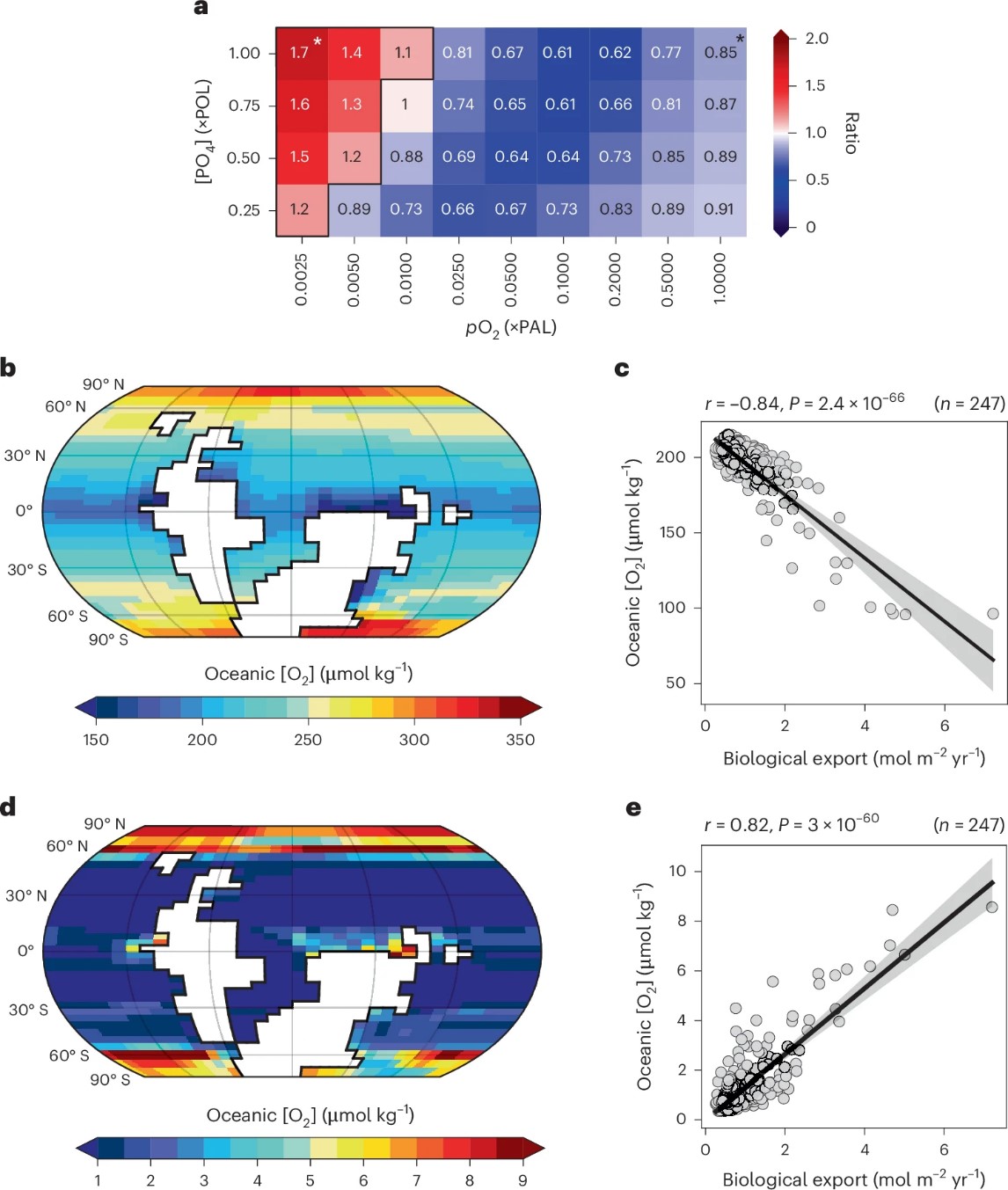
Figure 3 Spatial distribution of oxygen content in the upper ocean in the Earth system model and its correlation with productivity, b-c) pO₂ = 1 PAL, d-e) pO₂ = 0.0025 PAL.
The authors further quantified the relationship between increasing pO₂ and the reversal of the oxygen latitudinal gradient. First, 36 simulation results were obtained by combining different pO₂ levels (0.0025–1.0 PAL) and marine nutrient reservoir sizes ([PO₄], 0.25–1.0 POL). Second, the ratio of oxygen content in upper ocean waters at low latitudes (<15° N/S) to that at mid-to-high latitudes (15°–50° N/S) was calculated to quantify the latitudinal gradient: a ratio <1 indicates lower oxygen at low latitudes (Phanerozoic gradient), while a ratio >1 indicates higher oxygen at low latitudes (Proterozoic gradient). The results show that the pO₂ threshold for the reversal of the oxygen latitudinal gradient lies between approximately 0.5% and 1% PAL (present atmospheric level).
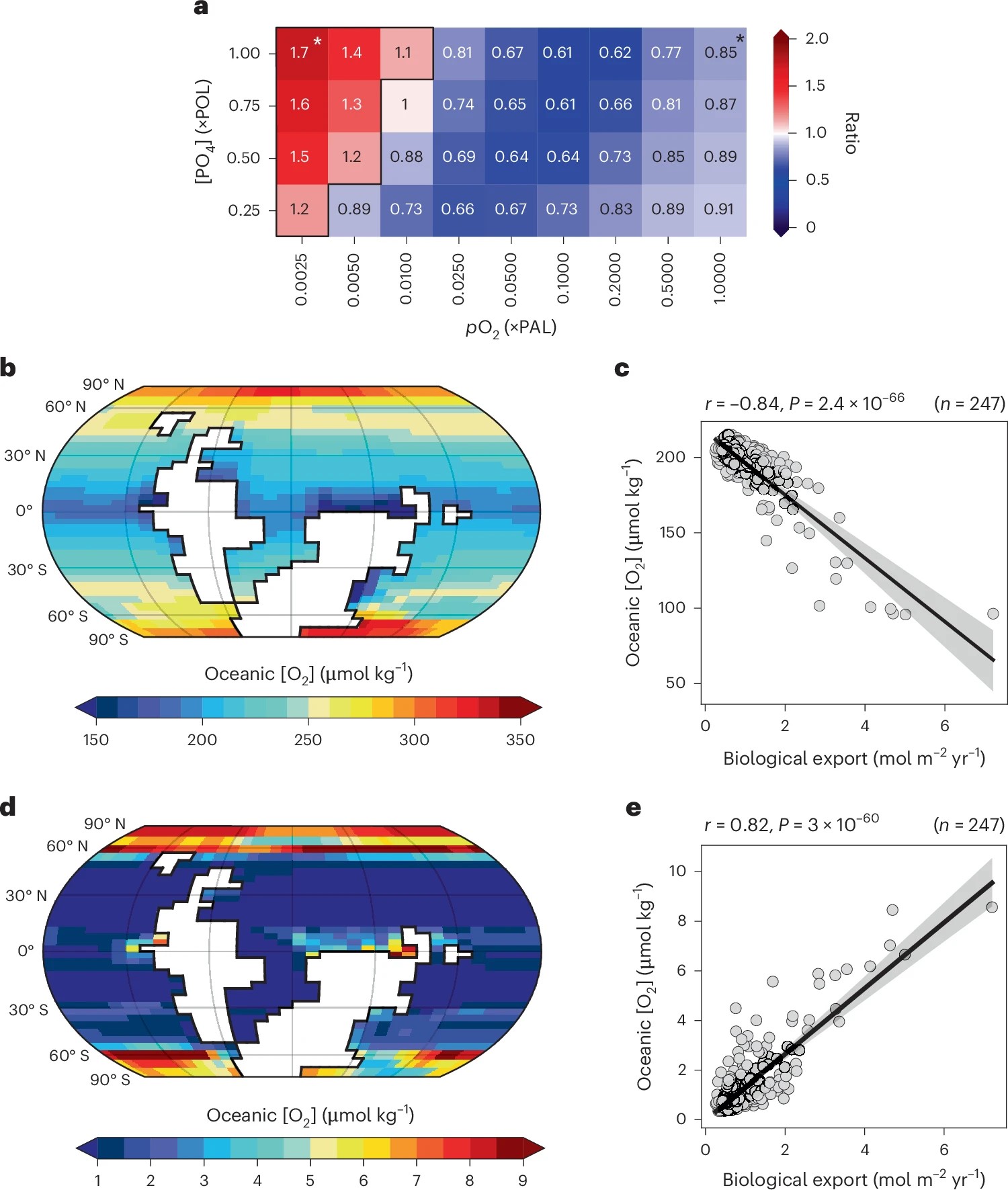
Figure 4 Oxygen latitudinal gradients under different atmospheric pO₂ and marine nutrient reservoir ([PO₄]) combinations. Ratio refers to the latitudinal oxygen ratio.
Evolution of Earth's habitable environment from a multidimensional perspective
The evolution of the latitudinal gradient in paleo-ocean oxygen content depicts, from both temporal and spatial dimensions, how atmospheric oxygen concentration and marine productivity controlled the transition of the ocean from scattered "oxygen oases" to a globally oxygen-rich state. This provides a multidimensional perspective on the evolution of Earth's habitable environment.

 1 Xuefu Avenue, Guodu Education Industrial Park, Chang'an District, Xi'an, Shaanxi Province
 710127
 029-88302202
 029-88302202
 geo_office@nwu.edu.cn
 English


 登录
登录


 Home
Home