An important breakthrough in plate tectonics theory in recent decades is the recognition that the continental crust can undergo deep subduction to mantle depths greater than 80-120 kilometers or even ultra deep subduction to mantle depths greater than 250-300 kilometers and return to the surface. Determining the maximum subduction reentry depth of the continental crust is of great significance for revealing the circulation of crustal materials, the interaction between the crust and mantle, the dynamics of deep mantle processes, and the evolution of the lithosphere. At present, there is no doubt about the subduction reentry depth of continental crust marked by ultra-high pressure metamorphic minerals such as coesite and diamond. However, there is still significant controversy and even suspicion regarding the subduction reentry depth indicated by the microscopic dissolution structure of certain special minerals, mainly due to the complexity and ambiguity of the genesis of mineral dissolution structures, as well as the lack of corresponding high-temperature and high-pressure experimental research on mineral dissolution. In response to the above scientific issues, Professor Liu Liang's team from the Department of Geology at Northwest University, together with Associate Professors Wang Chao, Xu Haijun, Zhang Junfeng from China University of Geosciences (Wuhan), and Dobrzhinetskaya Larissa from the University of California, USA, conducted a systematic experimental study based on the microstructure of pre-existing quartz exsolved kyanite+spinel observed in the South Altai mudstone gneiss. The experiment first synthesized a homogeneous single-phase aluminum containing quartz (Si0.97Al0.03) [O1.98
Ov0.01 (OH) 0.01] polycrystalline aggregate as the starting material under conditions of 17 GPa (equivalent to a depth of about 500 kilometers underground) and 1600 ℃ (Figure 1). Subsequently, a series of dissolution experiments were conducted by lowering the pressure to 10-2.5 GPa (equivalent to a depth of 300-70 kilometers underground) and 1200-1300 ℃, and for the first time, the evolution process of the microstructure of aluminum containing quartz dissolved in blue spar was fully reproduced. 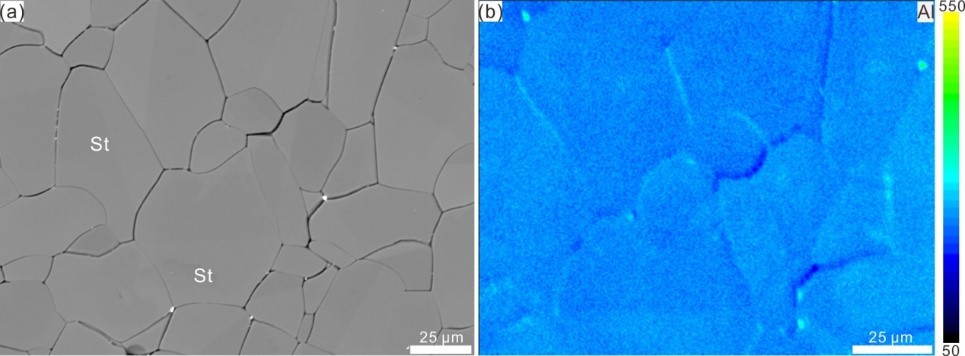
The experimental results show that:
(2) Aluminum dissolved in quartz is completely dissolved in two stages in the form of kyanite: the first stage occurs in the stable region of quartz and gradually dissolves with the decrease of temperature and pressure; The second stage occurs during the transition from quartz to coesite, characterized by a "sudden" dissolution process;
(3) When the voltage is reduced and cooled through the transition line between quartz and coesite (9 GPa and 1200 ℃), the coexistence of quartz and coesite can be seen at the low temperature end far from the thermocouple (Figure 2b). The continuous and parallel extension of the rod like bodies of kyanite derived from the internal dissolution of quartz and those inherited from coesite further confirms that coesite not only inherits the kyanite derived from the early dissolution of quartz, but also retains the crystal orientation of the early dissolution of quartz (Figure 2c);
(4) EBSD analysis of experimental products shows that there is a certain topological relationship between rod-shaped bluestone exsolution and quartz (Figure 3), while there is no obvious topological relationship between granular bluestone exsolution and quartz (Figure 4). Based on the crystal chemical characteristics analysis of aluminum containing quartz, the former may be related to Al3 in the solid solution of the parent mineral++

 1 Xuefu Avenue, Guodu Education Industrial Park, Chang'an District, Xi'an, Shaanxi Province
 710127
 029-88302202
 029-88302202
 geo_office@nwu.edu.cn
 English


 登录
登录


 Home
Home