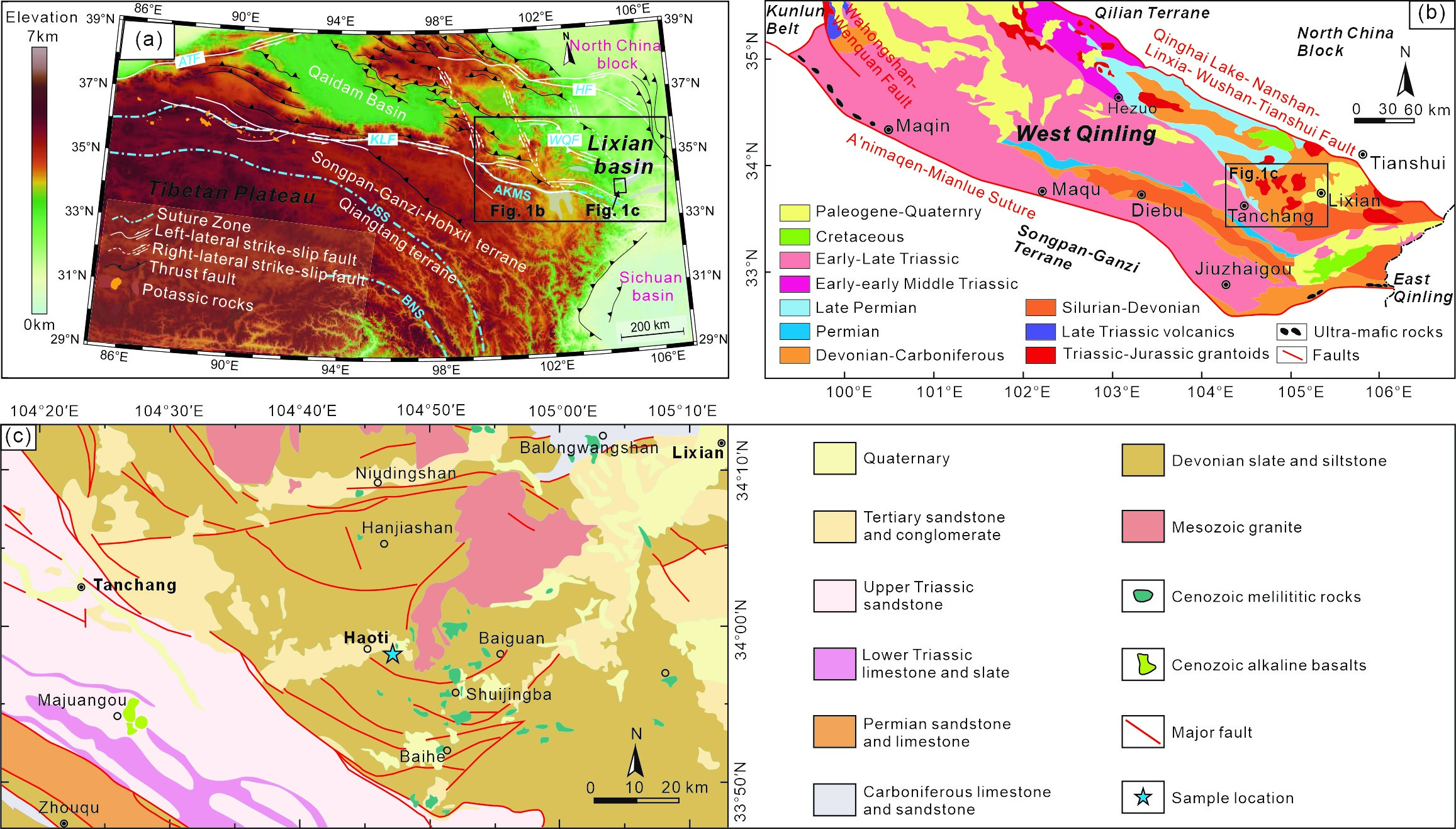
Silicon unsaturated alkaline rocks are characterized by low silicon, high alkali, and high carbon content. Their main rock types include deep mantle derived rocks such as kimberlite, diorite, and hornblende, making them excellent research objects for exploring key scientific issues such as the Earth's deep dynamics background, mantle metasomatism, and deep carbon cycling. However, there is still little research on the evolution of magma storage and transportation systems for such special rocks. In response to this scientific problem, Professor Lai Shaocong's team from the Department of Geology of Northwest University, in cooperation with researchers from the Institute of Oceanography of the Chinese Academy of Sciences, the British Museum of Natural History and the Yangtze University, selected Haoti Cenozoic melilite (Figure 1) in Lixian Dangchang area of the western Qinling in the northeastern margin of the Qinghai Tibet Plateau as the research object, and focused on various types of clinopyroxene and olivine phenocrysts to carry out fine mineralogical work to reconstruct its magma storage and transportation system, providing new clues for the evolution of silica unsaturated alkaline magma.
The following understanding has been mainly obtained:
(1) Identification of different types of pyroxene
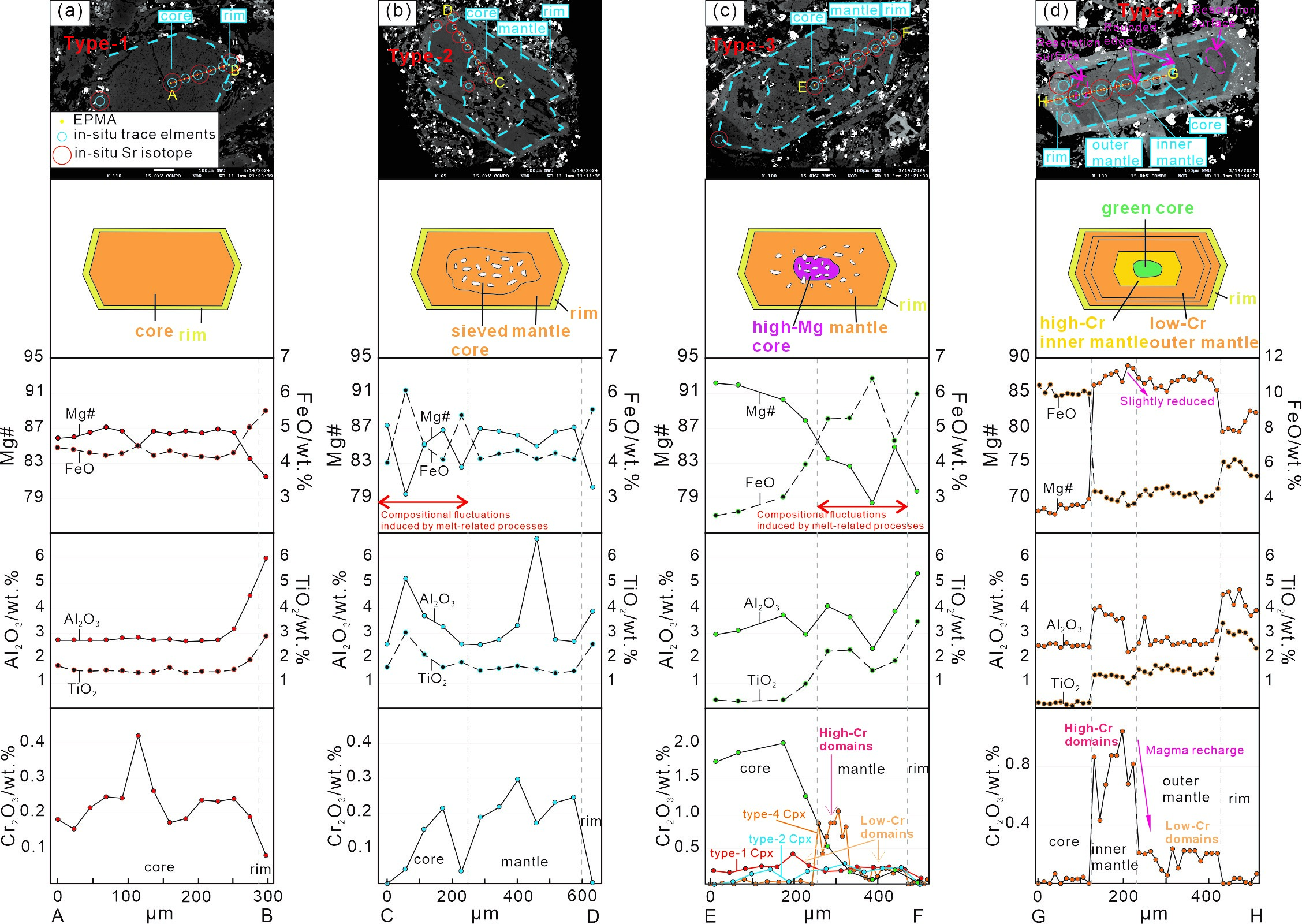
We identified four types of monoclinic pyroxene pyroxene pyroxene pyroxene pyroxene pyroxene pyroxene pyroxene pyroxene pyroxene pyroxene pyroxene pyroxene pyroxene pyroxene pyroxene pyroxene pyroxene pyroxene pyroxene pyroxene pyroxene pyroxene pyroxene pyroxene pyroxene pyroxene pyroxene pyroxene pyroxene pyroxene pyroxene pyroClean, with balanced composition and whole rock, it belongs to the self generated crystal of magma origin; The second type of clinopyroxene has a sieve like core mantle edge ring structure (Figure 2b), with larger fluctuations in Mg # values in the core compared to the mantle (Mg # values in the core: 79.5-87.3; The Mg # value in the mantle is 85.0-87.1, and the sieve shaped core contains mineral inclusions such as alkaline feldspar, magnetite, and apatite; The third type of clinopyroxene also exhibits a ring structure of core mantle edge (Figure 2c), with both the core and mantle showing sieve like structures. The significant difference is that the core has the highest Mg # value (87.8-92.2) and Cr2O3 content (1.25-2.00 wt.%). These compositional characteristics of the core are consistent with the clinopyroxene in the mantle xenoliths carried by the Haotihuangchang rock, indicating that its core belongs to mantle xenoliths; The fourth type of clinopyroxene has significant differences from other types of clinopyroxene, with clear boundaries between its core and mantle (Figure 2d). The core is rich in iron and low in magnesium (Mg # value: 67.1-70.3), exhibiting negative anomalies in Sr and Eu (δ Eu=0.30-0.49), balanced with feldspar, and showing a gentle heavy rare earth element (HREE) distribution pattern ((Gd/Yb) N=1.03-1.48). These characteristics indicate that the core of the fourth type of clinopyroxene is a lower crustal xenolith. In addition, the first type of olivine core has high CaO (0.23-0.38 wt.%) and MnO (0.09-0.29 wt.%) content, as well as low NiO content (0.04-0.29 wt.%). These compositional characteristics distinguish it from mantle xenoliths and indicate that it is a magma derived authigenic crystal; The second type of olivine core has a very high Fo value (85.9-87.0), accompanied by lower NiO content (0.04-0.29 wt.%) and higher CaO (0.23-0.38 wt.%) and MnO content (0.09-0.29 wt.%). These characteristics are highly consistent with the olivine in mantle xenoliths carried by Haotihuangchang rocks, which are mantle xenoliths.
(2) Magmatic processes revealed by the structural characteristics and compositional changes of clinopyroxene in Haotihuangyan
The Cr2O3 content in the mantle of the fourth type of clinopyroxene changes sharply, from a high value (up to 1.04 wt.%) to a low value (<0.4 wt.%) from the core to the edge direction (Figure 2c – d), revealing the existence of two batches of magma with different degrees of evolution in the Haotihuangyan magma storage and transportation system. The core of the second type of clinopyroxene, as well as the core and mantle of the third type of clinopyroxene, exhibit sieve like structures (Figure 2b – c). Revealed the addition of unbalanced alkali rich melt in the later stage.
(3) Crystallization environment of clinopyroxene in Haoti diorite
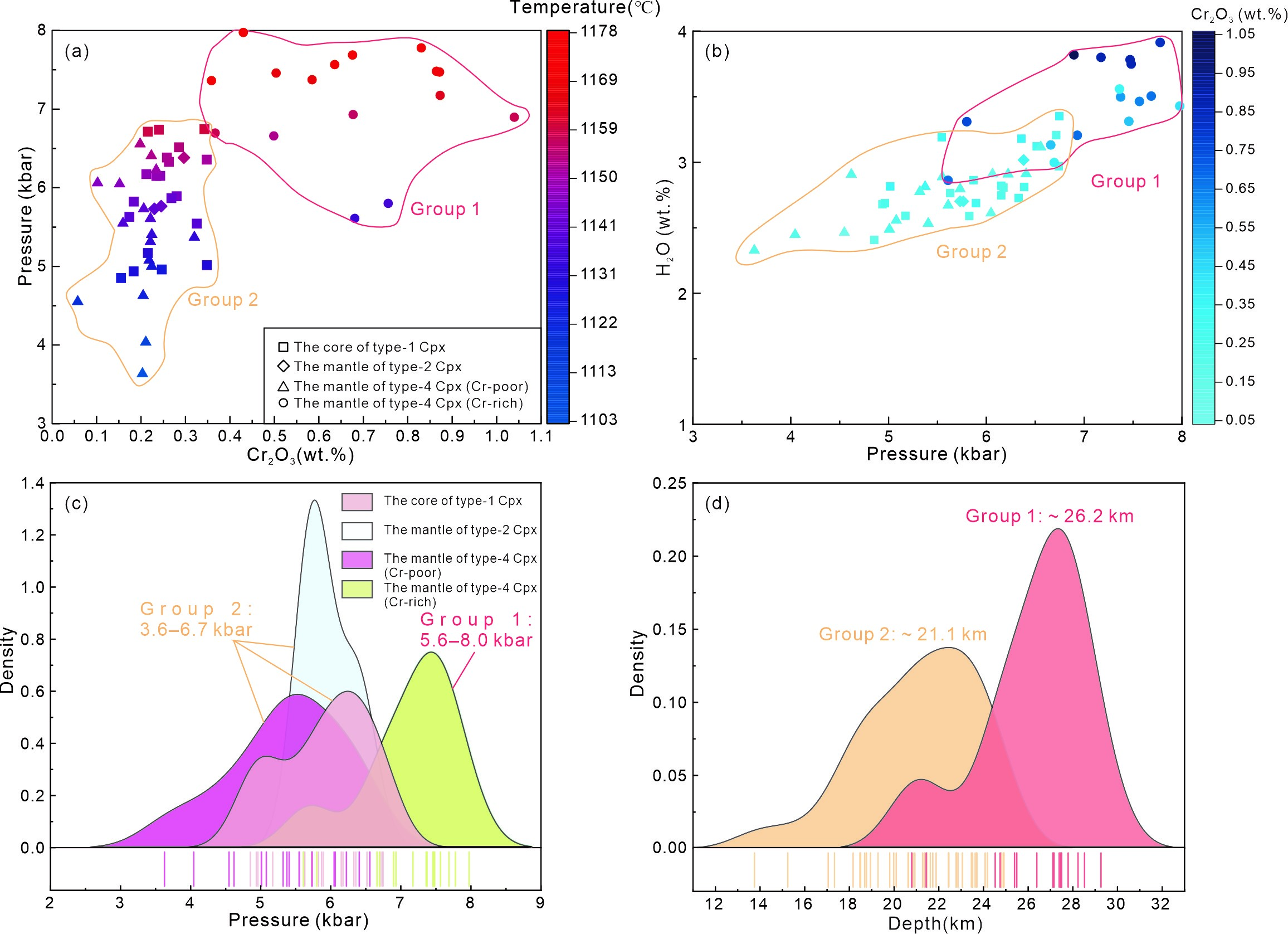
Quantitative calculation of temperature and pressure of clinopyroxene melt (Mollo et al., 2018) and empirical formula (Wass, 1979; Soeso, 1997) constrain three sets of crystallization temperature and pressure ranges: in all self generated clinopyroxene crystals, the Cr rich region crystallizes from 1132-1176 ℃/5.6-7.9 kbar, the low Cr region crystallizes from 1101-1158 ℃/3.6-6.7 kbar (Figure 3), and all edge crystals crystallize from lower temperature and pressure ranges, indicating Haoti. There are three magma reservoirs located at~26.2 km,~21.1 km, and shallower levels in the rock slurry storage and transportation system of Huangchang Rock (Figure 4).
(4) The properties of the magma source area
The restored melt composition in equilibrium with the self generated crystals of clinopyroxene shows high La/Yb (71.98-111.22), Dy/Yb (3.31-4.67), and Zr/Hf (47.29-55.62) ratios, as well as low Hf/Sm (0.55-0.87) and Ti/Eu (4939-5960) ratios, indicating its source area. Pomegranate phase replaced by carbonate melt. Olivine self generated crystals exhibit low NiO content (0.04-0.29 wt.%), low Ni/(Mg/Fe) 1000 ratio (<0.9), and high 100 × Mn/Fe ratio (up to 2.2), indicating that the source rock type is peridotite.
(5) Dynamic significance of the magma storage and transportation system of Haotihuangyan
The spatiotemporal distribution of Cenozoic volcanic rocks on the northern edge of the Qinghai Tibet Plateau shows a significant coupling relationship with the activity of regional deep fault zones. These magma tectonic activities are considered to be a response to the lateral growth of the Qinghai Tibet Plateau at its edge (Liu et al., 2018; Wei et al., 2023; Che et al., 2024).
. Recent mineralogical evidence suggests that magma supply/mixing processes are widely present in the magma storage and transportation systems of volcanic rocks on the northern edge of the Qinghai Tibet Plateau, such as the Dahongliutan potash volcanic rock on the northwest edge (Yang et al., 2023), the Maquan Gou alkaline basalt on the northeast edge (Zhang et al., 2024), and the Haoti diorite involved in this study. Therefore, we emphasize that during the outward growth of the Qinghai Tibet Plateau, major deep faults not only triggered decompression melting in the magma source area (Liu et al., 2018; Che et al., 2024), but also established favorable channels for subsequent batches of magma supply, thereby promoting volcanic eruptions.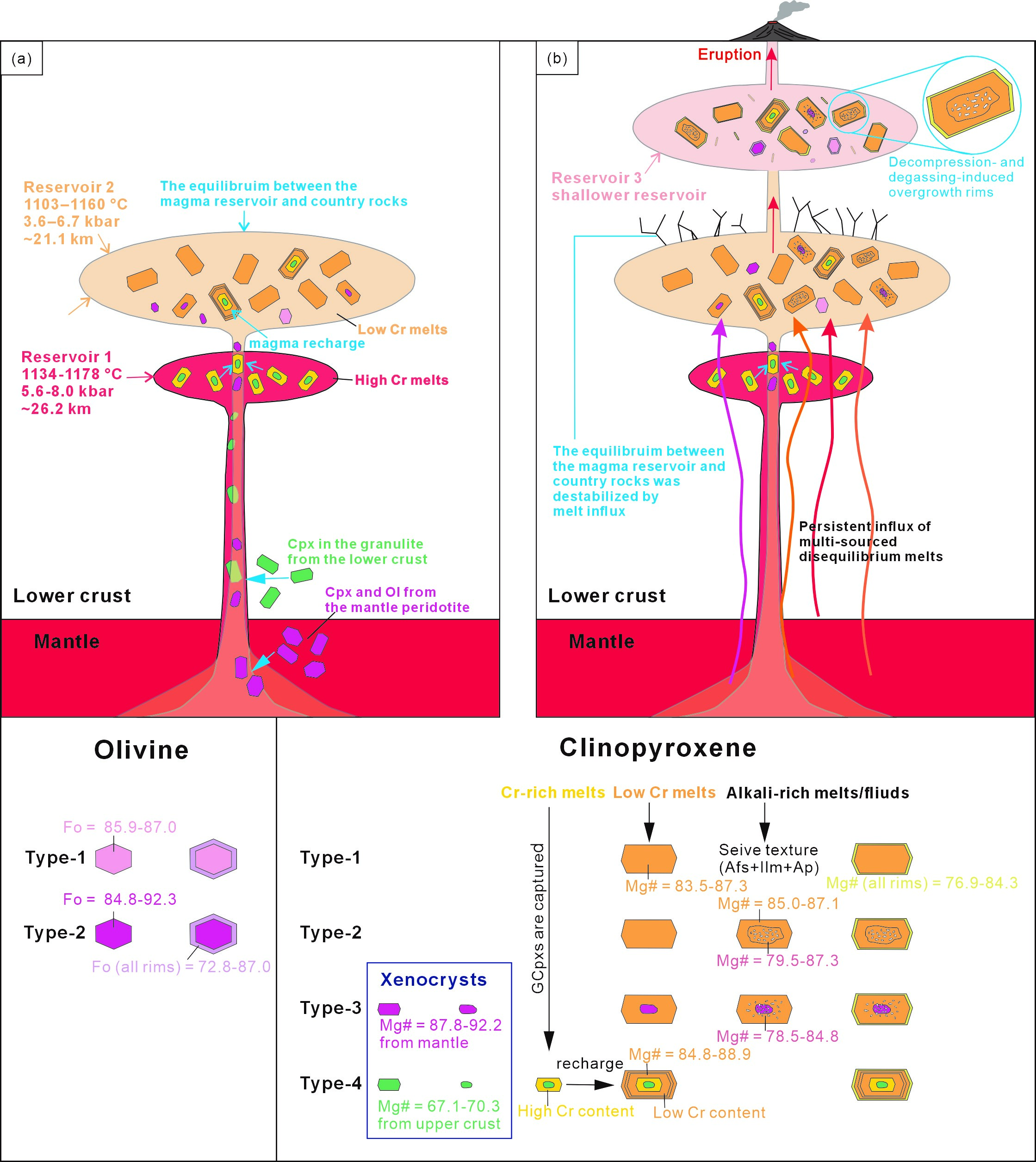
Original link: https://doi.org/10.1093/petrology/egag025

 No. 229, Taibai North Road, Xi'an, Shaanxi Province
 710069
 029-88302202
 029-88302202
 geo_office@nwu.edu.cn
 English


 登录
登录


 Home
Home