
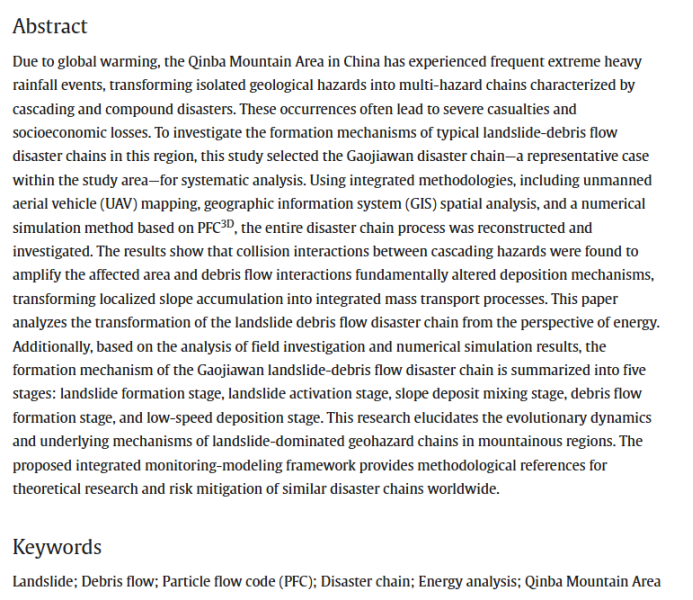
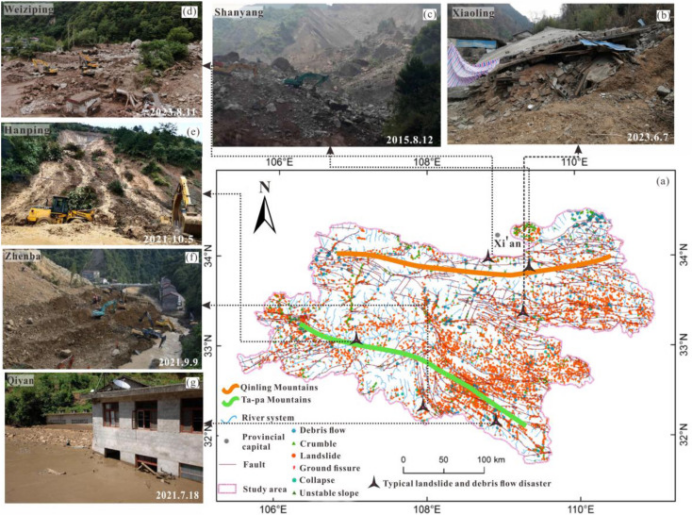
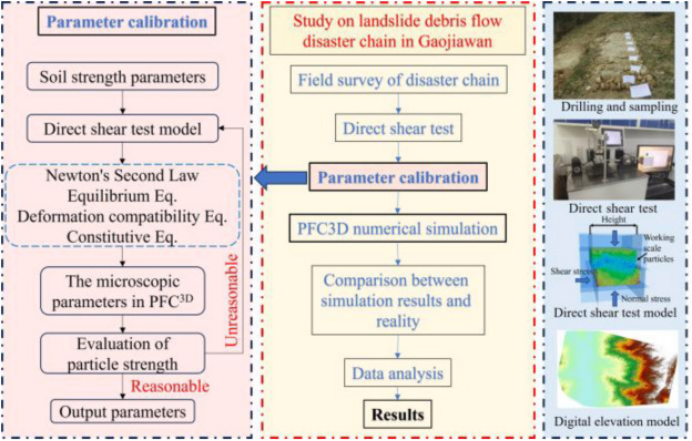
, the research shows that the evolution process of the landslide debris flow disaster chain induced by rainstorm in the Qinba Mountains can be divided into five stages: landslide formation stage, landslide initiation stage, slope sediment mixed stage, debris flow formation stage and low-speed accumulation stage. After the landslide started, two landslide bodies from different source areas collided and overlapped during movement, significantly expanding the impact range of the disaster chain (Figure 3).

Through velocity field analysis, it was found that after the collision of landslide bodies, the slope deposits that had already slowed down and accumulated were reactivated, and under the action of rainfall runoff, they were transformed into debris flows and continued to move downstream (Figure 4). Compared with a single landslide, the flow distance of the composite disaster chain after collision superposition has increased by about 30%, and the accumulation range has nearly doubled.
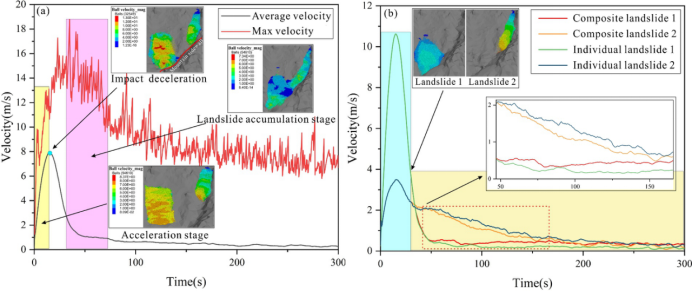
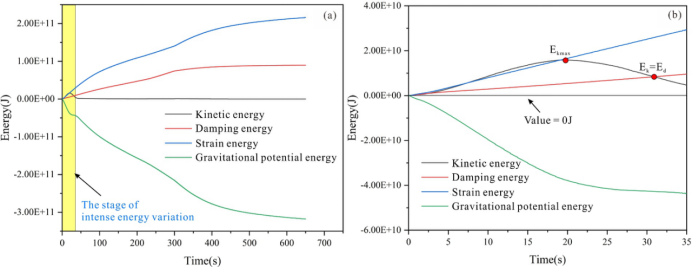
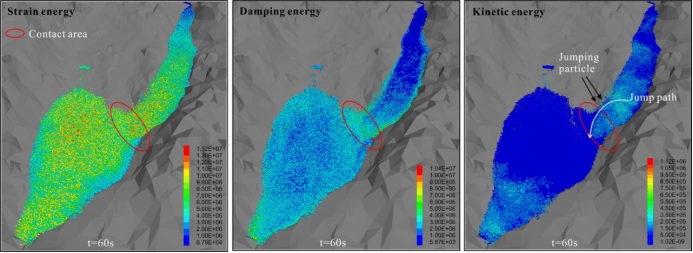
Energy analysis shows that during the landslide collision process, about 2/3 of the kinetic energy is converted into strain energy stored in the contact zone, and 1/3 is converted into damping energy consumption (Figure 5). This energy distribution mechanism ensures that the landslide mass after collision does not undergo violent ejection, but slowly merges in the form of "soft collision", which is conducive to the formation of subsequent debris flows (Figure 6).
The study also found that the thickness of the landslide significantly affects its motion mode: the thicker landslide (Slope 1) exhibits an overall sliding mode where the trailing edge pushes the leading edge, while the thinner landslide (Slope 2) exhibits a tensile sliding mode where the leading edge pulls the trailing edge. The difference between the two modes resulted in different response characteristics after collision (Figure 7).
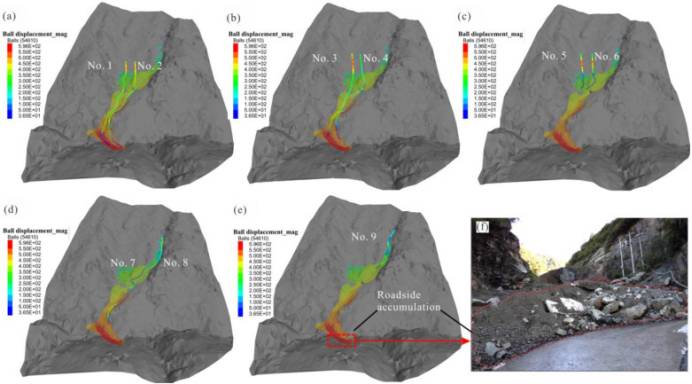
By comparing with field survey data, the numerical simulation results are in good agreement with the measured accumulation morphology, accumulation amount, and velocity characteristics, verifying the effectiveness of the model. Research has shown that the collision superposition effect is a key mechanism for amplifying the damage range of the disaster chain, while the debris flow process changes the accumulation mode of the disaster chain, transforming local slope accumulation into an overall channel transport process.
The Department of Geology of Northwest University and the State Key Laboratory of Continental Dynamics are the first units and communication units. This study was supported by the National Key Research and Development Program (2023YFC3008401) and the National Natural Science Foundation of China (42207184).
Paper information: Zhao A, Wang X*, Wang D, Hu S, Liu K, Lian B, Cao Y, (2026).Formation of a typical landslide-debris flow disaster chain induced by rainstorm, Journal of Rock Mechanics and Geotechnical Engineering.
Article link: https://doi.org/10.1016/j.jrmge.2025.11.028.
Related literature:
Yang JS; Wang XG*; Sheng Hu; Daozheng Wang; Baoqin Lian; Chen Xue; Kai Liu. (2025). Controlling effect of sliding zone soil on rainfall-triggered colluvial landslide in Qinling-Bashan Mountains-A typical case study. Earth Surface Processes and Landforms. 50(9):e70134.

 1 Xuefu Avenue, Guodu Education Industrial Park, Chang'an District, Xi'an, Shaanxi Province
 710127
 029-88302202
 029-88302202
 geo_office@nwu.edu.cn
 English


 登录
登录


 Home
Home