Explore the unsolved mystery of the "Zhongbulong transformation"
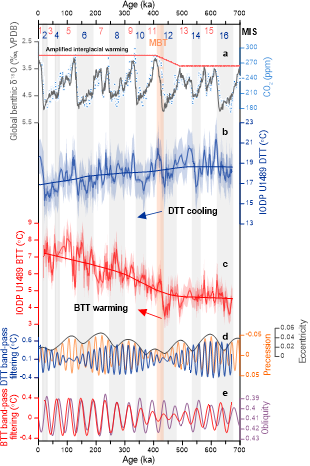
The Earth's climate underwent a major transformation about 430000 years ago, known as the "Zhongbulong transformation" (Figure 1).
. Afterwards, the global temperature and atmospheric carbon dioxide concentration significantly increased during the interglacial period, forming the warm period of the "Paleolithic Age" that humans relied on for evolution. The Zhongbulong transition, along with the earlier Middle Pleistocene transition (~1 million years ago) and the late Neogene Northern Hemisphere ice sheet growth (~2.7 million years ago), formed a continuous sequence, resulting in a long-term evolution trend of global climate gradually cooling, ice sheet growth, and intensified glacial cycles in the late Cenozoic era. However, the mechanism driving the transformation of Zhongbulong has long been a challenge in paleoclimatology. Regarding this climate transition, traditional research has mostly focused on processes such as the reorganization of deep-sea ocean circulation, the efficiency of marine biological carbon pumps, and the ocean atmosphere carbon cycle. However, so far, there has been no comprehensive answer to the reasons for the significant warming during the interglacial period after the "Zhongbu Rong transition". Recent research progress has shown that the internal heat of the ocean can undergo significant changes at the decadal, orbital, and even million year scales, directly generating climate effects. Especially the upper ocean, which interacts most closely with the atmosphere and responds to global warming, regulates heat transfer across hemispheres through shallow ocean overturning circulation. However, there is still little in-depth research on how the heat inside the ocean reorganizes during major paleoclimatic events such as the "Zhongbulong transition".Tropical Western Pacific "thermometer": using core samples from the tropical Western Pacific to reconstruct the changes in subsurface sea temperature over the past 670000 years
In response to the above issues, the research team selected core samples from the U1489 station drilled by the International Ocean Discovery Program (IODP) during its 363rd voyage at the center of the Western Pacific warm pool, and used Mg/Ca indicators of two planktonic foraminifera shells living at different depths to reconstruct the seawater temperature change history of the thermocline at a depth of about 200 meters and the bottom thermocline at a depth of about 330-600 meters, with a time span of about 670000 years.
. Due to its location in the core area of the Indo Pacific Warm Pool and the significant influence of mid-level water in the southern source, this station is particularly suitable for tracking oceanic connections between the tropics and the Southern Ocean.Important finding: Different depths of the thermocline show opposite evolution after the climate transition in the central region
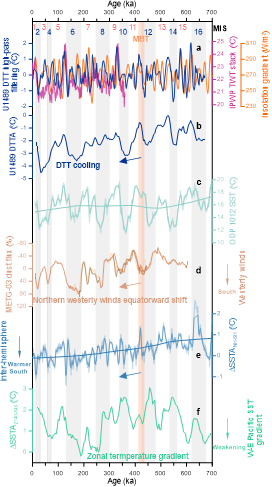
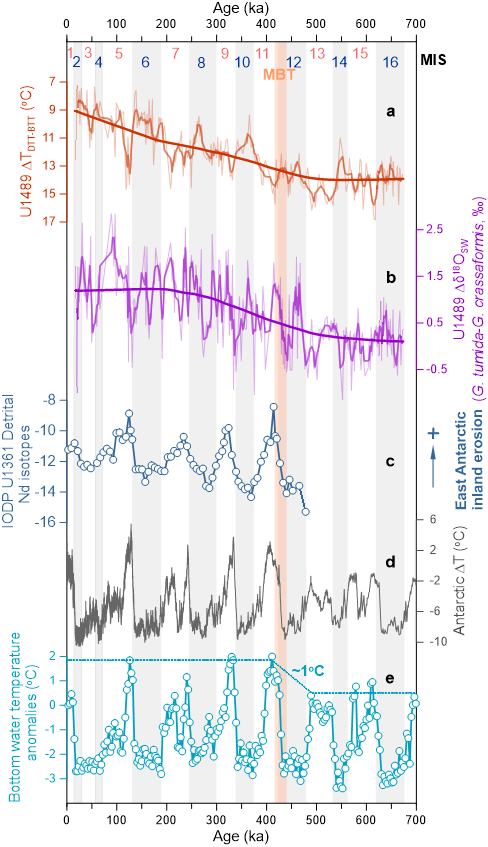
Research has found that since about 470000 years ago (corresponding to the boundary of deep-sea oxygen isotope MIS 13/12), the structure of the thermocline in the western Pacific warm pool has shown significant differentiation: the deep thermocline temperature (DTT; Figure 2) of seawater in the deep thermocline (~200 meters) has shown a long-term cooling trend.
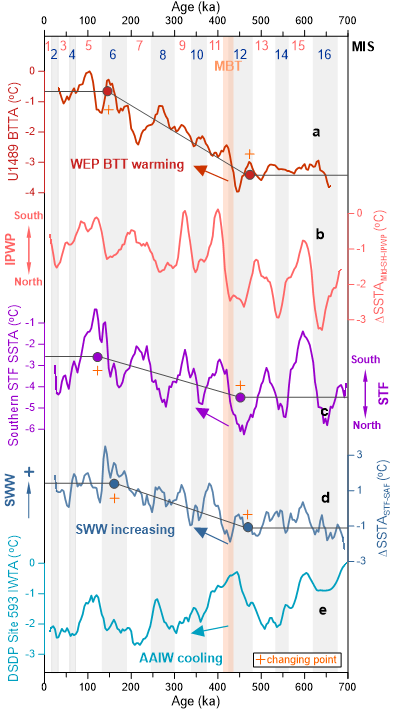
. This is consistent with the signals of shallowing of the tropical Pacific thermocline and contraction of the subtropical circulation in the northern hemisphere, indicating an increased impact of cooling signals from the northern hemisphere; At the bottom of the thermocline (~330-600 meters), the seawater temperature showed a significant upward trend of up to about 1.8 ℃ (bottom thermocline temperature, BTT; Figure 3). Sensitivity analysis confirms that this warming trend is independent of the choice of temperature conversion equation, and truly records the fundamental changes in the properties of water masses.Core innovation point: upper ocean "heat transfer belt" in mid to low latitudes
Research significance: To provide new geological references for understanding the high latitude low latitude linkage
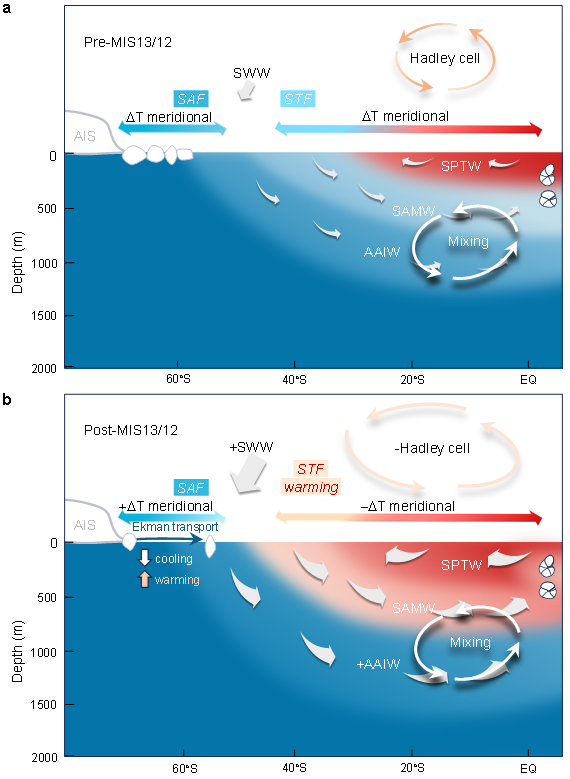
This study reveals a dynamic coupled heat redistribution system between low latitude warm pool thermal storage and high latitude Southern Ocean feedback from the perspective of cross hemisphere ocean heat transport, indicating that "climate evolution driven by low latitudes" may not occur in isolation, but through the joint action of warm pool heat redistribution, Southern Ocean heat absorption and subduction, and subsurface transport in a cross hemisphere chain.
. In this system, the Southern Ocean is not only an important region for global ocean heat absorption, but may also redistribute heat to low latitude tropical oceans through mid-level water circulation, thereby lifting the background heat state of interglacial periods. This study not only provides a new perspective for understanding the Zhongbulong transition, but also provides important geological references for understanding the linkage mechanism between the high latitude Southern Ocean and the low latitude tropics under the background of modern global warming. The first author of the paper is Dr. Yang Ce from Northwestern University (formerly a doctoral student at Tongji University), and the corresponding authors are Professor Dang Haowen from Tongji University and Professor Xu Jian from Northwestern University. Collaborators include Academician Jian Zhimin from Tongji University, Professor Franck Bassinot from Saclay University in Paris, Professor Yair Rosenthal from Rutgers University in the United States, and Associate Researcher Ma Xiaolin from the Institute of Geology and Environment, Chinese Academy of Sciences. This research is supported by projects such as the National Natural Science Foundation and the National Key Research and Development Program.Paper information:
Ce Yang, Haowen Dang, Jian Xu, Xiaolin Ma, Xingxing Wang, Yu Ren, Hongrui Zhang, Chen Li, Peng Zhang, Haijing Chen, Franck Bassinot, Yair Rosenthal & Zhimin Jian. Equatorward upper-ocean heat transport from the Southern Ocean boosted interglacial warming. Nature Communications, 2026, https://doi.org/10.1038/s41467-026-71829-7.

 1 Xuefu Avenue, Guodu Education Industrial Park, Chang'an District, Xi'an, Shaanxi Province
 710127
 029-88302202
 029-88302202
 geo_office@nwu.edu.cn
 English


 登录
登录


 Home
Home