The 180-80 million year period connects the Paleoproterozoic Great Oxidation Event (2.43-2.06 Ga) and the Neoproterozoic Atmospheric Oxygenation Event (0.85-0.54 Ga), and is an important stage in the evolution of the Earth's surface oxidation history. For a long time, the academic community has generally believed that the atmospheric oxygen content during this period was extremely low, and due to environmental changes and slow biological evolution, it was known as the "Boring Billion" in Earth's history. However, an increasing number of studies suggest that the atmospheric oxygen content during this period may not have been stable for a long time, but rather experienced periodic increases. Although various geochemical indicators and numerical simulations have estimated the atmospheric oxygen concentration at that time, there is still significant controversy over the relevant understanding, and the range of oxygen content variation is also very broad.
Ancient soil and weathering crust are products formed by the interaction between surface weathering and the atmosphere, which can directly record ancient atmospheric environmental information and are important carriers for reconstructing the early Earth's oxidation history. The Jixian area of the Yanliao Basin in the North China Craton is widely distributed with ancient weathering crust formed about 1.4 billion years ago, with a thickness of about 1 meter. It was formed by weathering and leaching of carbonate rocks, and has relatively intact preservation of environmental evolution information at that time (Figure 1).
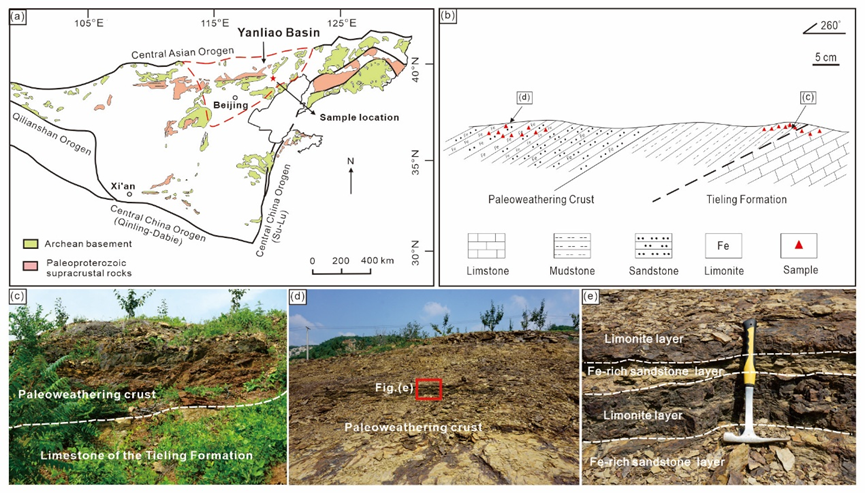
By conducting systematic geochemical research on the ancient weathering crust in Jixian County and combining it with the kinetic oxygen mass balance model of divalent iron oxidation, the required atmospheric oxygen content during the formation process was quantitatively constrained under strict constraints on key parameters such as the duration of weathering crust formation, annual rainfall, and groundwater level. Research has found that there are significant differences in the degree of oxidation recorded in different layers of the weathering crust: the upper rock layers react fully with oxygen and exhibit higher oxidation characteristics; The lower rock layers recorded relatively low levels of oxygen. Research suggests that this is due to the preferential reaction of free oxygen with divalent iron in the upper rock layers during the downward infiltration of oxygen-containing fluids, which is gradually consumed. It is worth noting that the divalent iron in the lower rock layer was also completely oxidized, indicating that there was sufficient free oxygen in the fluid at that time. Based on this feature, the research team quantitatively reconstructed the atmospheric oxygen concentration at that time using the oxygen demand of the surface rocks of the weathered crust. The results show that about 1.4 billion years ago, the lowest atmospheric oxygen concentration on Earth reached nearly 7% of the current atmospheric oxygen content (PAL) (Figure 2). This result is significantly higher than the 0.1% -1% PAL proposed by traditional research, and is consistent with the 4% -9% PAL results obtained from some numerical simulations in recent years.
Combining global contemporaneous high oxygen records, the study proposes that a global oxygenation event may have occurred about 1.4 billion years ago, and the evolution trajectory of atmospheric oxygen in the Mesoproterozoic is more complex than previously known. This study reconstructed atmospheric oxygen levels through ancient weathering crust, providing a new perspective for revealing the early oxidation history of the Earth and laying an important foundation for understanding the conditions for early environmental evolution and life development.
Zhao Xuechun, a master's student from Northwest University, is the first author of the paper, and Professor Long Xiaoping and Associate Professor Lan Caiyun are co corresponding authors of the paper. The National Key Laboratory of Continental Evolution and Early Life at Northwestern University and the Joint Center for Earth and Planetary Sciences between Northwestern University and the University of Hong Kong are the first units, and this research is supported by multiple National Natural Science Foundation projects.
Paper information:
Zhao X., Lan C., Long X. Oxygen rise recorded in a 1.4 Ga paleoweathering crust from the North China Craton. Science Bulletin 71: 2183-2187 (2026).

 1 Xuefu Avenue, Guodu Education Industrial Park, Chang'an District, Xi'an, Shaanxi Province
 710127
 029-88302202
 029-88302202
 geo_office@nwu.edu.cn
 English


 登录
登录


 Home
Home