The Oronbrook block has a unique "dual geological attribute". On the one hand, the pre Cambrian basement, Cambrian sedimentary sequence, and early paleontological assemblages indicate that before the Early Ordovician, the Eulunbulake block had close geological connections with the North China block and can be regarded as an important component of the southern margin of the North China block. On the other hand, after entering the Middle Ordovician Darewerian stage, its fossil assemblage showed a more similar biogeographical affinity to the South China Plate, suggesting that it may have undergone important tectonic migration processes. At the same time, in the current tectonic framework, the Eulunbuluk block and the North China plate are separated by the Central Qilian block, which has long been believed to originate from the South China plate (Figure 1), further increasing the complexity of the tectonic evolution in the region.
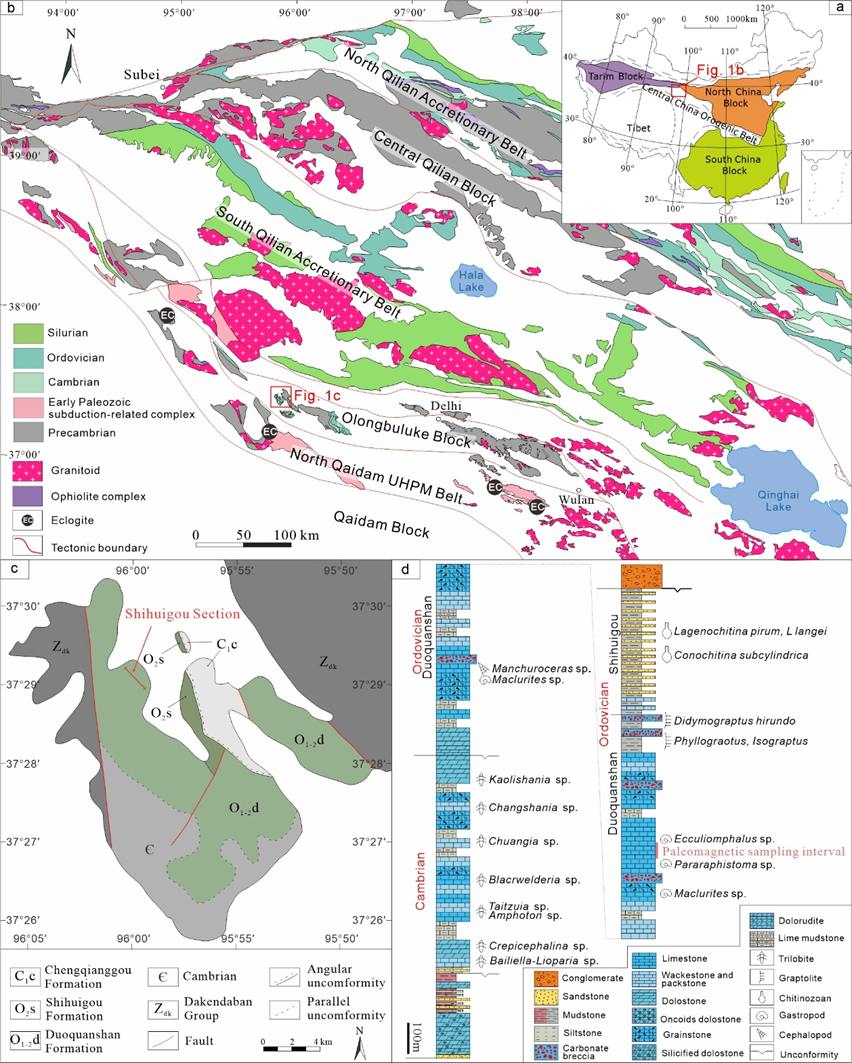
The above geological phenomenon raises two key scientific questions: when did the Eulongnabuluke block begin to separate from the North China plate? Why did the Central Qilian Block appear between the Eulunbuluk and North China Plate? This not only relates to the tectonic evolution of the Eulunbuluk block itself, but also directly affects the understanding of the evolution history of the original Tethys Ocean and the early assembly process of the East Asian continent.
In response to the above issues, the research team selected the Middle Lower Ordovician Duoquanshan Formation limestone in the Oulongbulake block to conduct systematic paleomagnetic research (Figure 1). The research results indicate that during the Early to Middle Ordovician period, the Oronbrook block was located at approximately 27.5 ° (± 5.6 °) south latitude. Compared with the paleomagnetic results of the North China block during the same period, it was found that there is already a north-south distance difference of about 2720 ± 890 km between the two (Figure 2). This result indicates that the Oronbuk Block was not permanently fixed at the edge of the North China Block, but began to drift southward during the Late Cambrian and gradually separated from the North China Block.
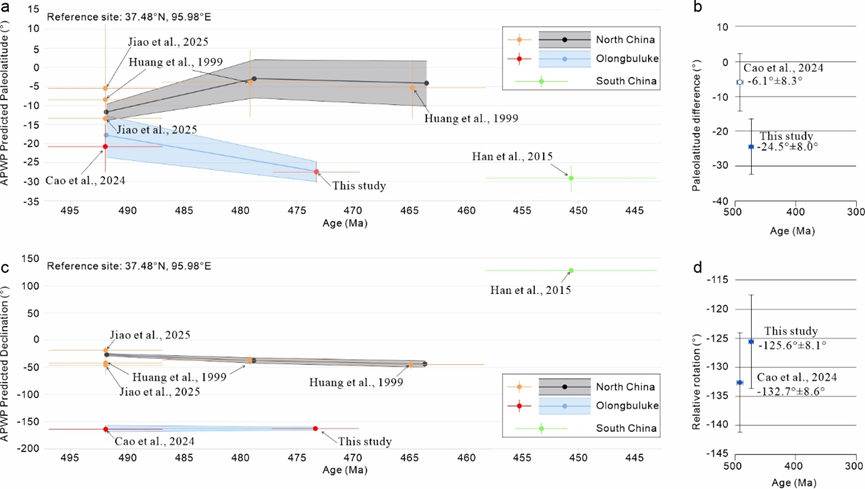
Combining paleontological, detrital zircon source analysis, and regional tectonic evolution evidence, the research team further proposed the tectonic evolution model of the Oulongbulake block: after the Late Cambrian, the Oulongbulake block separated from the southern edge of the North China block and continued to drift southward; During approximately 467-458 Ma, it collided with the South China Plate. Subsequently, the Oronbuk Block and the Central Qilian Block separated from the edge of the South China Plate and underwent a counterclockwise rotation of approximately 130 ° during subsequent tectonic evolution, ultimately reassembling into the North China Plate with the closure of the original Tethys Ocean (Figure 2, 3).
This research result not only provides direct paleomagnetic constraints for the drift history of the Eulunbuluk block, but also provides new key evidence for revealing the evolution of the original Tethys Ocean and the early tectonic reorganization of the East Asian continent.
. However, there is still a lack of clear explanation for why the Euronbrook plot has undergone such significant rotation. Behind it may involve complex processes such as plate boundary transformation, changes in subduction polarity of ocean basins, oblique collisions between blocks, or later tectonic transformations. In the future, more high-precision paleomagnetic, sedimentological, tectonic geological, and geochronological studies are still needed to further improve the migration path and underlying dynamic evolution mechanism of the Oronbrook block.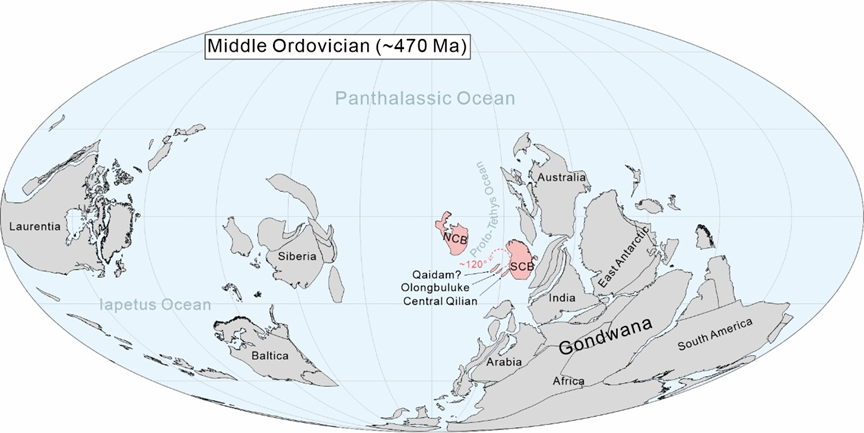
The relevant research results were published in the international academic journal Geophysical Research Letters under the title "Paleomagnetic Constraints on the Separation of the Olongbuluke Block from the North China Block During the Late Cambrian Middle Ordovician and Its Tropical Significance".
. Wang Teng, a postdoctoral fellow in the Department of Geology at Northwestern University, is the first author of the paper, and Associate Professor Zhou Yanan from the Department of Geology at Northwestern University is the corresponding author.Paper information: Wang, T. (Wang Teng), Zhou, Y. (Zhou Yanan), Chai, R. (Chai Ruiyang), Cheng, X. (Cheng Xin),& Wu, H. (Wu Hanning) (2026). Paleomagnetic constraints on the separation of the Olongbuluke Block from the North China Block during the Late Cambrian – Middle Ordovician and its tectonic significance. Geophysical Research Letters, 53, e2025GL119613 https://doi.org/10.1029/2025GL119963
Reference:
Dong, Y., Sun, S., Santosh, M., Zhao, J., Sun, J., He, D., et al. (2021). Central China orogenic belt and amalgamation of East Asian continents. Gondwana Research, 100, 131–194. https://doi.org/10.1016/j.gr.2021.03.006
Sun, J., Dong, Y., Jiang, W., Ma, L., Chen, S., Du, J., & Peng, Y. (2020). Reconstructing the Olongbuluke Terrane (northern Tibet) in the end‐neoproterozoic to Ordovician Indian margin of Gondwana. Precambrian Research, 348, 105865. https://doi.org/10.1016/j.precamres.2020.105865
Torsvik, T. H., & Cocks, L. R. M. (2017). Earth history and palaeogeography. Cambridge University Press.
Wang, T., Zhou, Y., Chai, R., Cheng, X., Wang, P., Xing, L., et al. (2023). Microcontinental block amalgamation in the northern Tibetan Plateau and its significance for understanding the closure of the Proto‐Tethyan Ocean. Palaeogeography, Palaeoclimatology, Palaeoecology, 627, 111722. https://doi.org/10.1016/j.palaeo.2023.111722
Zhao, G., Cawood, P. A., Wilde, S. A., & Sun, M. (2002). Review of global 2.1–1.8 Ga orogens: Implications for a pre‐rodinia supercontinent. Earth Science Review, 59(1–4), 125–162. https://doi.org/10.1016/S0012 ‐8252(02)00073‐9

 1 Xuefu Avenue, Guodu Education Industrial Park, Chang'an District, Xi'an, Shaanxi Province
 710127
 029-88302202
 029-88302202
 geo_office@nwu.edu.cn
 English


 登录
登录


 Home
Home