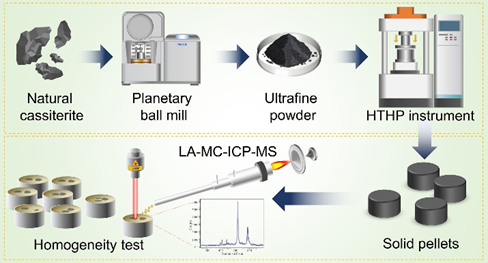
Figure 1 Schematic Diagram of the Process of Preparation and Homogeneity Evaluation of Synthetic Cassiterite Reference Materials
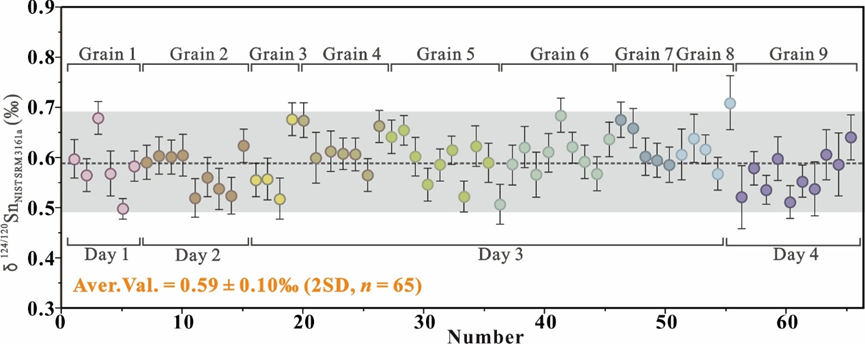
In response to the above problems, the team of Yuan Honglin and Liu Peng from Northwest University, together with the Institute of Geochemistry of the Chinese Academy of Sciences and Leibniz University in Hanover, Germany, prepared ultrafine cassiterite powder into massive cassiterite samples through high-temperature and high-pressure technology, and carried out a systematic evaluation around its Sn isotope determination, micron scale homogeneity and cross laboratory applicability (Figure 1). This reference material is prepared in 4 batches, with a total amount of approximately 28 grams, which can meet the needs of long-term use and inter laboratory sharing. The SN-MC-ICP-MS analysis results showed that the recommended δ 124/120Sn value relative to NIST SRM 3161a was 0.63 ‰ ± 0.02 ‰ (2SD, n=14). According to ISO Guide 35:2017, the uncertainty introduced by the constant value process, inter unit homogeneity, and long-term stability was further comprehensively evaluated, and the extended uncertainty was calculated to be approximately 0.07 ‰ (k=2). To test the micrometer scale uniformity and cross laboratory applicability of the substance, Northwestern University completed 1333 in-situ analysis tests over a period of more than 12 months, while Leibniz University Hanover in Germany conducted 65 analysis tests on randomly selected sample particles. The results obtained by both laboratories were consistent with the recommended values of the solution method within the uncertainty range (Figure 2), indicating that the reference substance has good Sn isotope uniformity, long-term stability, and inter laboratory applicability.
Paper information: Jing Tian, Zhian Bao*, Peng Liu*, Sen Lin, Stefan Weyer, Ingo Horn, Kaiyun Chen, Honglin Yuan. Synthetic Cassiterite Reference Material for High-Precision In Situ Sn Isotope Analysis by LA-MC-ICP-MS. Analytical Chemistry, 2026. doi: https://doi.org/10.1021/acs.analchem.6c02154.
First author introduction: Tian Jing, graduated from Northwestern University with a PhD in Science in 2025, under the guidance of Professor Yuan Honglin. In the same year, she was selected as one of the first batch of Wisteria postdoctoral scholars at Northwestern University, with Professor Liu Peng as her co supervisor.
.
 1 Xuefu Avenue, Guodu Education Industrial Park, Chang'an District, Xi'an, Shaanxi Province
 710127
 029-88302202
 029-88302202
 geo_office@nwu.edu.cn
 English


 登录
登录


 Home
Home