The Cenozoic era is a critical period for the global climate to gradually shift from a "greenhouse" to an "ice house". Over the past approximately 60 million years, the global average temperature has continued to decline, ultimately forming the ice covered climate of today's North and South Poles. For a long time, scientists have generally believed that the tectonic uplift in regions such as the Qinghai Tibet Plateau has enhanced the weathering of continental silicates, consuming more atmospheric CO ₂ and driving global climate cooling through long-term carbon cycling. However, this hypothesis faces a long-standing paradox: if tectonic uplift can continuously enhance silicate weathering, then CO ₂ in the atmosphere could theoretically be completely consumed on a scale of millions of years, leading the Earth's climate towards extreme cold states and ultimately falling into a runaway freeze similar to a "snowball Earth". But the real Earth system clearly did not develop along this path. What mechanism is used to timely 'step on the brake' during the continuous global cooling process, preventing the world from entering a frozen Earth?
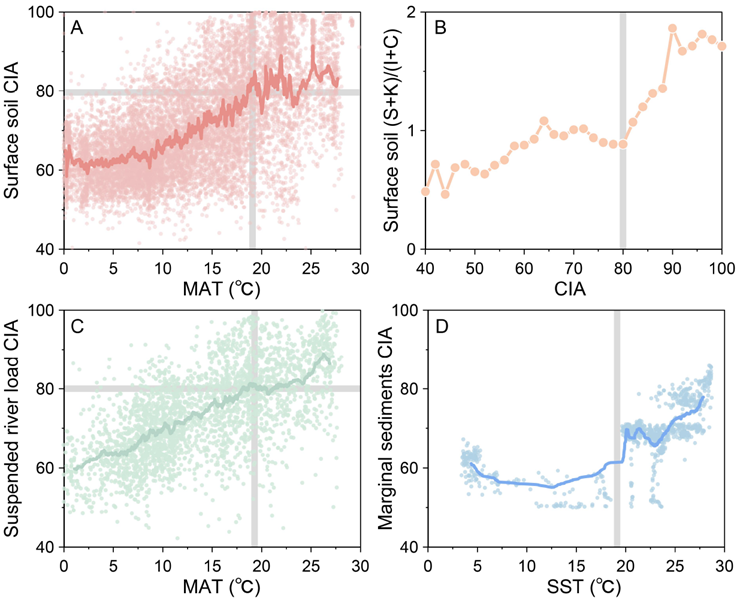
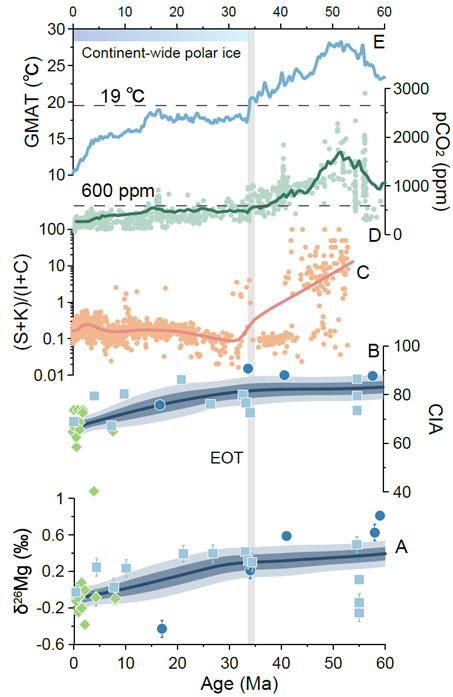
To solve the long-standing "ice house paradox", the research team combined magnesium isotopes (δ ² ⁶ Mg) with chemical alteration indices (CIA) to reconstruct the long-term evolution history of silicate weathering intensity (SWI) in the Cenozoic continent. Magnesium isotopes undergo significant fractionation during continental weathering and have two important advantages. On the one hand, the magnesium isotope composition of weathered parent rocks in the upper crust is relatively uniform, providing a good benchmark for global scale weathering tracing. On the other hand, during chemical weathering, lighter ² ⁴ Mg will preferentially enter the fluid phase, while heavier ² ⁶ Mg is more likely to be retained in secondary clay minerals, resulting in significant isotope fractionation. Therefore, the δ 2 ⁶ Mg in sediments can record the migration of magnesium and the formation of secondary minerals during continental weathering, and is an effective indicator reflecting changes in weathering intensity. The research team used magnesium isotope composition information preserved in marine sediments to track changes in continental weathering processes over millions of years. By analyzing the silicate components of marine sediments from passive continental margins in the Pacific, Atlantic, and Indian Oceans, records of continental silicate weathering from the Cretaceous to the present have been obtained. The results show that there is a significant turning point in the weathering evolution of the Cenozoic continent. During the early Cenozoic greenhouse period, the sediment δ ² ⁶ Mg remained at 0.29 ‰ -0.46 ‰, and the CIA remained at 81-84 ‰. Both indicators were at a relatively high and stable level, indicating that the global continental silicate weathering intensity was high at that time. However, during the Eocene Oligocene Transition (EOT, approximately 34 Ma), this stable state underwent a fundamental change. The δ ² ⁶ Mg value began to continuously decrease and has now dropped to about -0.09 ‰ by modern times; The CIA value also decreased from 82 to 67 simultaneously. Two independent indicators show a highly consistent trend of change, indicating that the global continental silicate weathering intensity has continued to weaken since approximately 34 Ma. Why does the weathering intensity of continental silicates undergo such a fundamental change before and after EOT? In order to explore the mechanisms behind this change, the research team further integrated modern global soil, river suspended matter, and Quaternary continental margin sediment observation data, and found that there is an important climate threshold for continental silicate weathering, which is an annual average temperature of 19 ° C and an atmospheric CO ₂ concentration of 600 ppm. This threshold divides continental weathering into two climate states with different response characteristics.
Greenhouse period: There is an "upper limit" to weathering enhancement. When the global temperature exceeds about 19 ° C and the concentration of CO ₂ exceeds about 600 ppm, the secondary clay minerals produced by continental weathering are mainly kaolinite and montmorillonite. In the process of intense chemical weathering, a large amount of active cations such as calcium, magnesium, sodium, and potassium have been leached out, causing CIA to reach a high level and tend to saturate. Therefore, even if the temperature continues to rise, the intensity of weathering is difficult to infinitely increase. Ice chamber period: Cooling significantly reduces weathering efficiency. When the temperature drops below 19 ° C and the concentration of CO ₂ drops below 600 ppm, the situation changes. The secondary clay mineral assemblage gradually shifts towards illite and chlorite. These minerals contain more active cations, and at the same time, low temperatures significantly reduce the rate of chemical weathering reactions. The result is that although the rocks are still weathered, more elements are retained and 'locked' in secondary minerals, and not fully released into river and ocean systems. Therefore, cooling not only reduces the intensity of weathering, but more importantly, reduces the efficiency of CO ₂ consumption per unit of rock weathering.
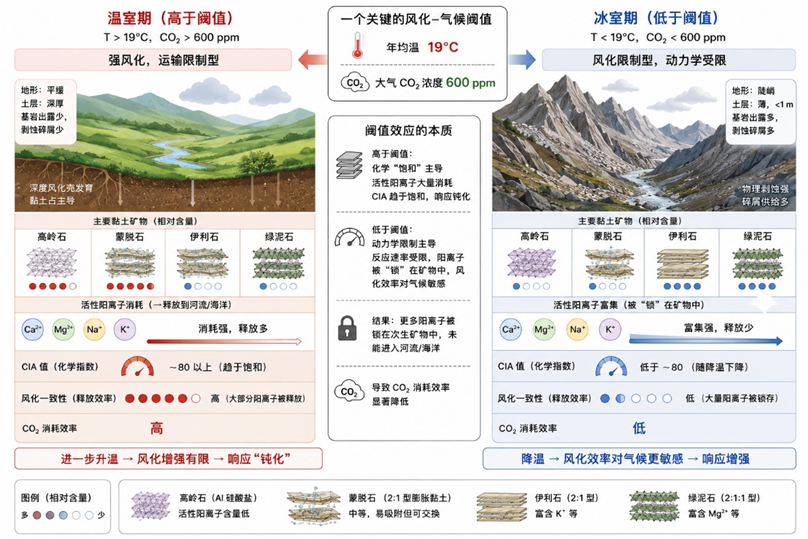
This study suggests that the Earth's climate system is not passively receiving the result of tectonic activity, but can form inherent negative feedback through the climate dependence of weathering efficiency. When the climate is warm enough, weathering can strongly consume CO ₂; But as the global temperature continues to cool and crosses critical climate thresholds, weathering efficiency decreases, and the ability to consume CO ₂ is suppressed, thereby weakening the driving force for further cooling. This negative feedback mechanism, which is regulated by the climate itself, provides a new perspective on why the Earth has been able to maintain a relatively stable and suitable environment for the existence of life throughout its long geological history. The Earth is not only driven by tectonic and climatic changes, but also able to 'self regulate' these changes through its own geochemical processes. Zhang Pan, a postdoctoral fellow in the Department of Geology at Northwest University, is the first author of the paper, and Professor Huang Kangjun is the corresponding author. The main collaborators include Professor Fang Zhen Teng from the University of Washington, Assistant Professor Yan Hu from the University of Nevada, Las Vegas, Associate Professor Ma Long from Northwestern University, and Dr. Tianyi Huang from Nantong University. This research is supported by the National Natural Science Foundation of China project (424021154273061) and the doctoral follow-up project (2024M752617). The research team sincerely thanks the International Ocean Drilling Project for providing samples and support.
Paper information: Zhang, P., Huang, K.-J., Hu, Y., Teng, F.-Z., Ma, L., Huang, T.-Y., 2026. A climatic threshold regulating Cenozoic silicate weathering and climate stability. Earth Planet. Sci. Lett. 694, 120315. https://doi.org/10.1016/j.epsl.2026.120315

 1 Xuefu Avenue, Guodu Education Industrial Park, Chang'an District, Xi'an, Shaanxi Province
 710127
 029-88302202
 029-88302202
 geo_office@nwu.edu.cn
 English


 登录
登录


 Home
Home