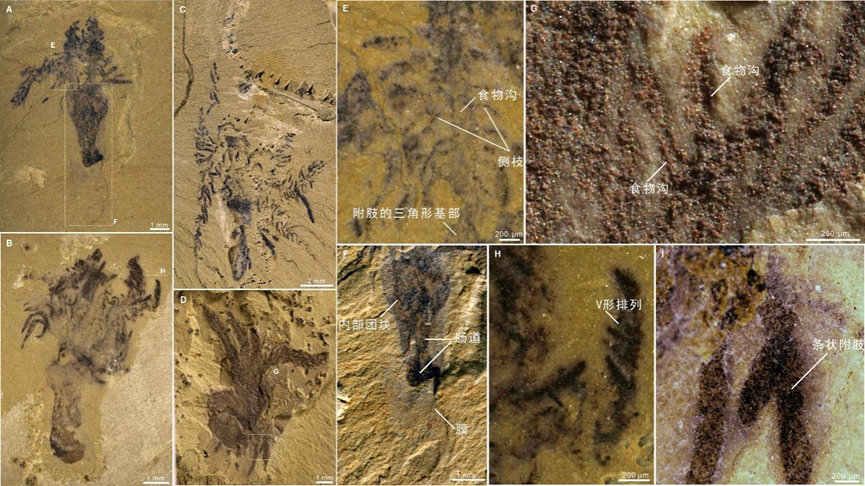
(A) Protype specimen ELI-EJ053; (B) Subtype specimen ELI-JS033A; (C) Specimen ELI-JS188A; (D) Specimen ELI-JS005A; (E) Local feather like appendages, displaying the filtering groove, lateral branches, and triangular base of the appendages; (F) Lower torso, displaying dark internal masses, intestines, and light colored membranes surrounding them; (G) Feathered appendages, showing food troughs; (H) Local feather like appendages, displaying a V-shaped arrangement of lateral feather branches; (I) Local strip-shaped appendages.
Steppe animals are one of the two core branches of post oral animals, including echinoderms and hemichordates with great morphological contrast (Figure 3). The concept of this group was first born in 1881. The famous Russian zoologist Mechnikov found that echinoderms (such as starfish and sea lilies) and hemichordates (such as stigma worms and cephalopods) have highly homologous characteristics by comparing the embryonic development and larval morphology of the subphylum of post oral animals. For the first time, the two were merged and named "Ambulacaria". The original meaning of the step belt is the groove on the surface of echinoderms covered with tube feet, used for movement and feeding (Figure 3A). But in the following century, this classification viewpoint was long controversial in the academic community: researchers identified chordal structures in the snout of hemichordates, and at one point classified hemichordates as primitive relatives of vertebrates in the phylum Chordata, while the classification status of sauropods was put on hold. It was not until 1998 that molecular systematics research confirmed the close relationship between two types of organisms at the genetic level, and the clade of sauropod animals was once again recognized by the academic community.
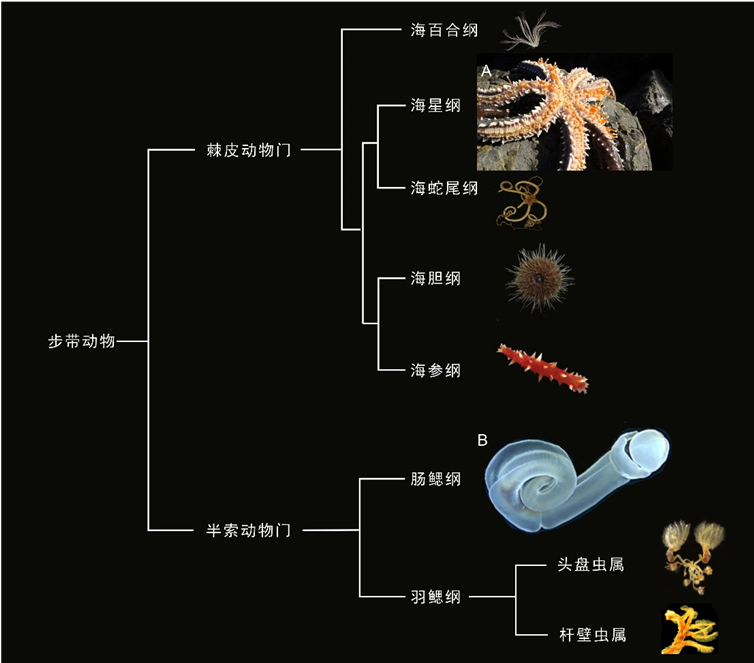
(A) Step zone and tube foot on the ventral surface of starfish (Image source: Nickwilso/Wikimedia Commons, CC BY-SA 4.0); (B) The stigma worm.
The concept dust settles, and new core scientific challenges emerge: Where is the evolutionary origin of step animals? What kind of physical structure did their last common ancestor possess? In the past century of paleontological research, there has been a lack of key fossil evidence, and the origin mechanism of the five radiation symmetrical bodies of echinoderms and the worm shaped bodies symmetrical on both sides of hemichordates has always been an unresolved mystery in evolutionary biology. Chordates, echinoderms, and semichordates together form the backbone of the evolution of postoral animals, with vastly different body configurations and feeding methods among the three major categories. Reconstructing the appearance of the ancestors of sauropods is the core key to solving the mystery of postoral animal differentiation. For a long time, the mainstream hypothesis has been that the last common ancestor of sauropods was a worm like organism without tentacles that relied on pharyngeal filtering for food, with a morphology similar to modern stigma worms. The detailed dissection and phylogenetic analysis of the Yujingchong fossil directly challenges this traditional understanding that has been used for many years from the perspective of physical fossils.
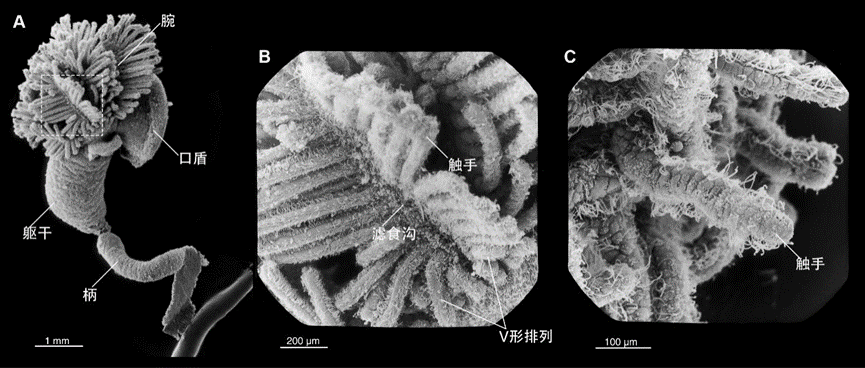
In this study, a total of 4 beautifully preserved soft bodied specimens of the Jade Purifier were discovered, all of which were from the Chengjiang Fossil Library of the Cambrian Period III in Kunming, Yunnan 518 million years ago. The total length of the specimens is about 8.5-22 millimeters (Figure 1). Fossils preserve the body, intestines, and appendages intact, making them rare early step animals worldwide without mineralized bones. Two distinct sets of upward and outward extending top appendages can be clearly seen on the upper part of the specimen: one is six symmetrically distributed feather feeding tentacles, covered with alternating V-shaped arrangement and upward pointing side feather branches. The tentacle has a longitudinal filtering groove in the center of the near mouth surface, which is highly homologous in structure to the feeding organs of modern echinoderms such as sea lilies and hemichordates such as cephalopods (Figure 4 and 5); The second type is slender and smooth appendages: located in the lower layer of feather like appendages, it is speculated to be used for temporary anchoring and stabilizing body posture on the seabed.
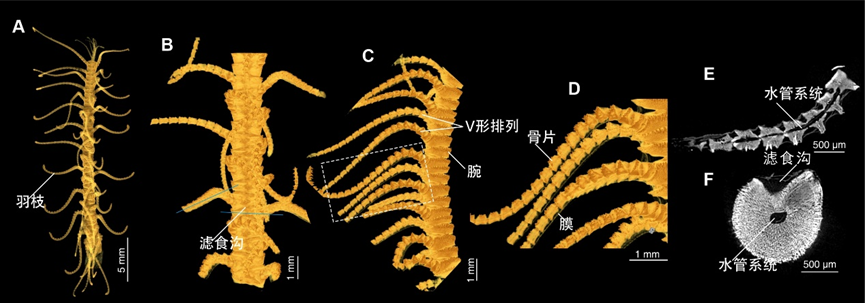
(A) Overall morphology of a single wrist, showing alternating feather branches on both sides; (B) Partial enlarged view of the wrist, showing the filtering groove extending along the center of the wrist; (C) Partial enlarged view of the side of the wrist, showing the V-shaped arrangement of feather branches; (D) Localized enlargement of feather branches, showing bone fragments and membranes; (E) The cross-section of the feather branch shows the water pipe system; (F) The transverse section of the wrist shows the filtering groove and water pipe system.
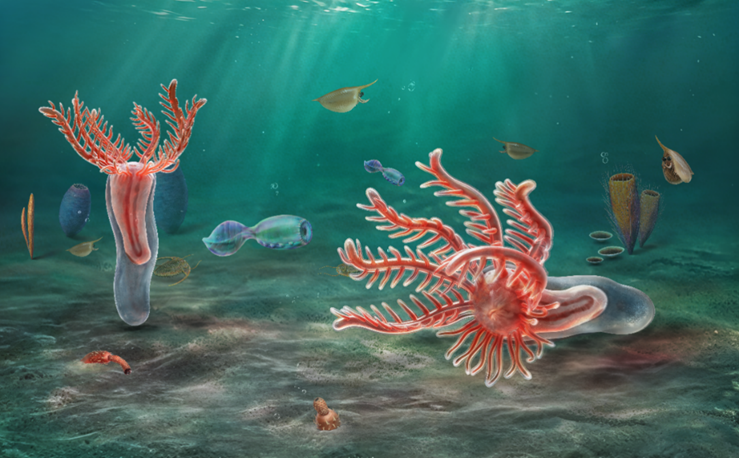
The upper part of the trunk is a dark colored visceral area, with a faintly visible U-shaped curved intestine inside; The lower part of the torso is a light colored, seemingly transparent film (Figure 1). With the help of multiple methods such as fluorescence microscopy, scanning electron microscopy, and micro CT three-dimensional reconstruction, the team reconstructed the complete anatomical structure and living posture of the Jade Cleansing Worm: this ancient organism is a semi-solid suspended filter eater, mainly relying on feather like tentacles to capture organic particles in seawater (Figure 2).
The first author of this study, He Kaiyue, a doctoral student in the Department of Geology at Northwestern University, introduced the origin of the new species name: "This ancient organism is elongated and bottle shaped as a whole, with outstretched upper tentacles and a rounded lower body. Its appearance is in line with the shape of the jade purification bottle held by Guanyin Bodhisattva in traditional Chinese culture, so it is named 'Jade Purification Worm' in Chinese. All fossil specimens preserve a light colored native thin film that wraps around the visceral mass, with a soft texture like a gelatinous film, which is the most intuitive identification feature of this species, and therefore the species name is determined based on this."
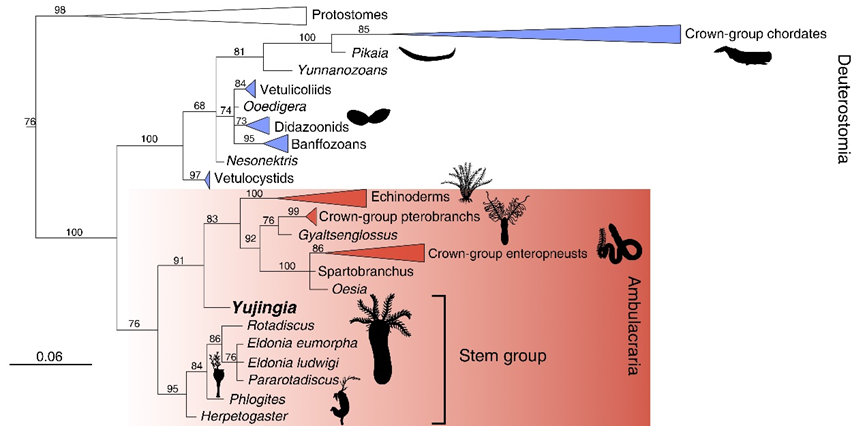
Bayesian phylogenetic analysis based on 100 taxa and 505 morphological features, with numbers at nodes indicating posterior probabilities (%); The scale bar is located in the lower left corner)
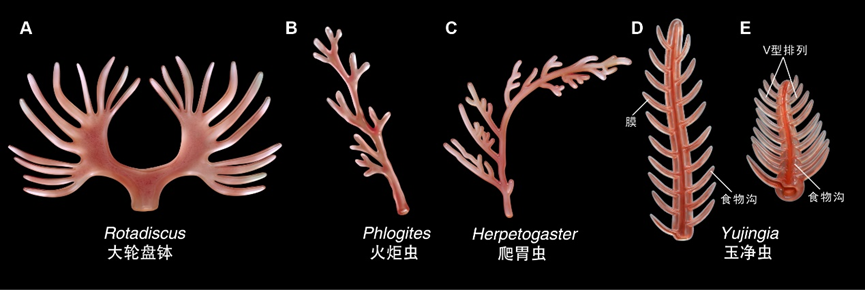
Doctoral student He Kaiyue and Dr. Giovanni Mussini from the University of Cambridge constructed a large evolutionary matrix containing 505 morphological features and 100 ancient and modern biological groups. Using Bayesian system development and reconstruction, they clarified the evolutionary position of the Jade Cleansing Bug: The Jade Cleansing Bug fossils are closer to the last common ancestor of modern step belt animals than the previously discovered Cambrian Cambrian Cambrian Cambrian Cambrian Cambrian Cambrian Cambrian Cambrian Cambrian Cambrian Cambrian Cambrian Cambrian Cambrian Cambrian Cambrian Cambrian Cambrian Cambrian Cambrian Cambrian Cambrian Cambrian Cambrian Cambrian Cambrian Cambrian Cambrian Cambrian Cambrian Cambrian Cambrian Cambrian Cambrian Cambrian Cambrian Cambrian Cambrian Cambrian Cambrian Cambrian CambriThe key transitional fossil (Figure 6). Compared with the fossil of Cambrian Qixu insects (Figure 7), Yujing insects have multiple mosaic features: (1) they have a smooth cylindrical soft body of Cambrian feather limbs, but no calyx stalk differentiation, and no calcareous mineralized bones; (2) A fine filtering tentacle system with similar morphology and function to modern echinoderms such as sea lilies and hemichordates such as cephalopods, and possibly homologous; (3) The absence of the iconic kiss collar torso three segment body and three part body cavity of hemichordates proves that the ancestral morphology of sauropods is much more primitive than that of modern hemichordates.
Ancestral state reconstruction results confirm that the closest common ancestor of the two phyla of annelids has already evolved a complex tentacle feeding system, rather than the previously thought tentacle free worms that rely on pharyngeal gill slits for feeding.
. The calcareous skeleton of echinoderms and the unique snout of modern nematodes are highly likely secondary features that evolved independently in later stages.Why is this type of specimen so rare? Dr. He Kaiyue believes that this is closely related to the origin and evolution of step belt like bones. The most primitive step belt species, represented by the Yujingchong, although appeared in the third stage of the Cambrian, have not yet evolved mineralized skeletons, resulting in extremely low fossil preservation probability and susceptibility to predation, making it difficult to occupy a dominant position in the ecosystem. On the other hand, since the fourth stage of the Cambrian period, echinoderms such as sea lilies and sea flat fruits have evolved calcified endosomes that rapidly radiate and become dominant groups among steppe animals. The Ordovician period saw a major radiation event involving echinoderms, with the diversity and abundance of groups such as sea lilies, sea lilies, sea buds, and sea stars reaching their peak. Sea lily reefs were widely developed on the seafloor, forming the most prosperous stage in the evolutionary history of echinoderms. At the same time, semichordates represented by penmanship evolved organic matter exoskeletons and developed social lifestyles, achieving large-scale radiation during the Late Cambrian Silurian period.
Academician Shu Degan delves into the relationship between filter feeding tentacles and gill slits: In step walking organisms, both the tentacle (or wrist branch) and gill slits undertake "basic metabolic functions", which combine feeding and respiratory functions.
. Gill slits are limited to the pharyngeal area, and efficiency can be improved by increasing the number of slits and expanding the surface area; And the tentacles outside the body can extend to a large area of water, with a wider filtering and breathing area. The functions of the two are highly overlapping, forming a clear trade-off relationship of resource competition and mutual growth in evolution. If the tentacle system continues to refine, the gill slits will gradually shrink and degenerate; On the contrary, the focus is on the development of gill slits, while the structure of tentacles is constantly simplified. This evolutionary trade-off logic directly drives different lineages of theropod animals to embark on completely different evolutionary paths: the stigma worms in theropod animals have many gill slits (7-700 pairs), their tentacles degenerate, and evolved snouts to adapt to mud drilling life. The remaining semichordates vigorously developed multifunctional tentacle branches, while gill slits continued to degrade, eventually differentiating into five radiation symmetrical calcified animals such as fixed colonies of penmanship, clubworms, starfish, and sea lilies.Corresponding author, Researcher Han Jian, believes that this study simultaneously clarifies two long-standing controversial scientific issues: first, clarifying the origin of feeding methods in sauropod animals: 518 million years ago, sauropod animals had evolved highly refined tentacle suspension filter feeding organs, and the origin time of characteristic filter feeding grooves, alternating feather branches, and V-shaped tentacle arrangement structures in echinoderms was much earlier than previously speculated by the academic community;
; The evolutionary balance of tentacles and gill slits in the Cambrian period may directly lead to the complete differentiation of different lineages within the steppe animals. Secondly, filling the core gap in the fossil record of post Cambrian animals: Yujingchu fills the morphological gap between primitive Cambrian feathered animals and modern echinoderms and hemichordates, proving that the tentacle system and feeding organs of echinoderms share a common ancient origin, and their similar structures are not convergent evolution, but inherited from a common ancestor over 500 million years ago.In order to strengthen the reliability of fossil morphology interpretation, the team simultaneously conducted comparative simulation experiments on the decay of extant sea lilies, verifying that the light colored thin film of the fossil is a primitive body wall of the organism, not an illusion formed during the burial process, and providing solid burial support for the entire evolutionary inference (Figure 8).
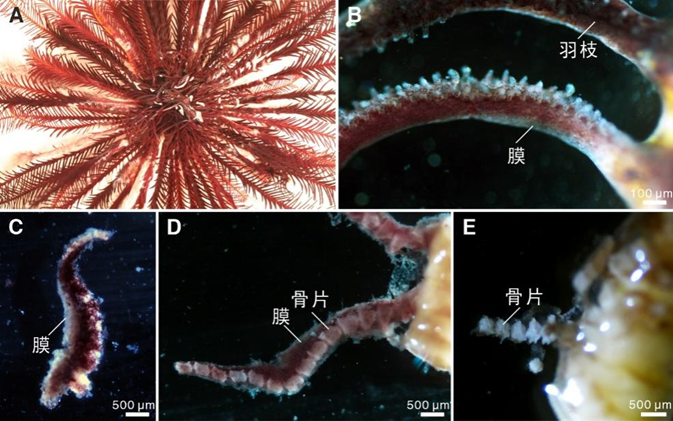
(A) Photos of living feather stars; (B) The wrist after self cutting and detachment; (C, D) Wrist naturally decomposed in seawater for 4 days; (E) The wrist naturally decomposed in seawater for 6 days.
This achievement was published under the title "Cambrian fossils Illuminate the Ambularian Common Ancestor" in the international journal Current Biology under Cell Press. The first author is He Kaiyue, a doctoral student in the Department of Geology at Northwestern University, and the corresponding author is Researcher Han Jian from the Department of Geology at Northwestern University. Academician Shu Degan from Northwestern University, Giovanni Mussini from the University of Cambridge, Mike Reich from the National Museum of Natural History in Brunswick, Germany, and Ou Qiang from China University of Geosciences (Beijing) jointly participated in the research. Relying on the State Key Laboratory of Continental Evolution and Early Life of Northwest University and the Shaanxi Provincial Key Laboratory of Early Life and Environment, the research has been funded by the National Key Research and Development Program, the National Natural Science Foundation of China, the 111 Talent Introduction Program, the National Public Scholarship Fund and other grants.
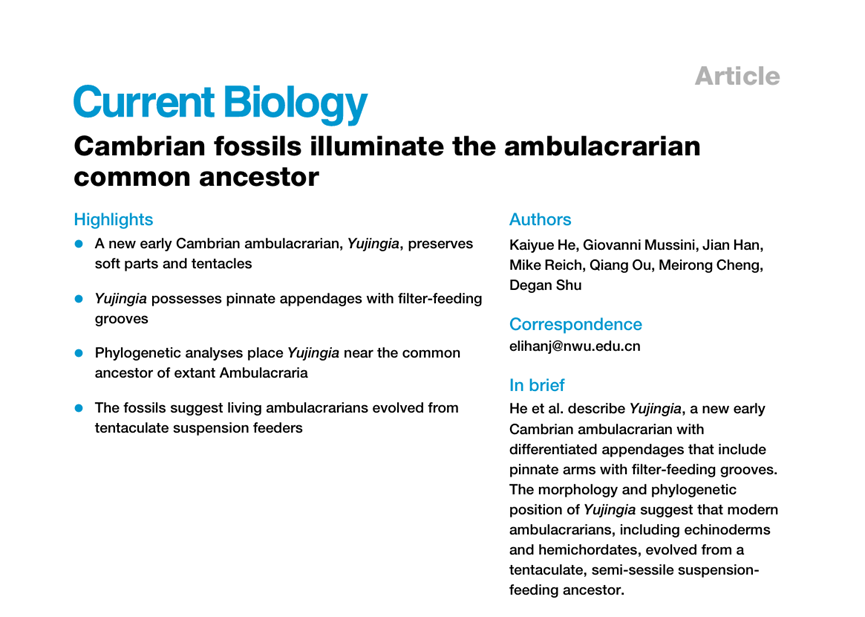
Paper information: Kaiyue He, Giovanni Mussini, Jian Han *, Mike Reich, Qiang Ou, Meirong Cheng( Cheng Meirong and Degan Shu, Cambrian fossils illuminate the ambulacrarian common ancestor. Current Biology, 2026, DOI: 10.1016/j.cub.2026.08.053.
Original link: https://doi.org/10.1016/j.cub.2026.08.053

 1 Xuefu Avenue, Guodu Education Industrial Park, Chang'an District, Xi'an, Shaanxi Province
 710127
 029-88302202
 029-88302202
 geo_office@nwu.edu.cn
 English


 登录
登录


 Home
Home