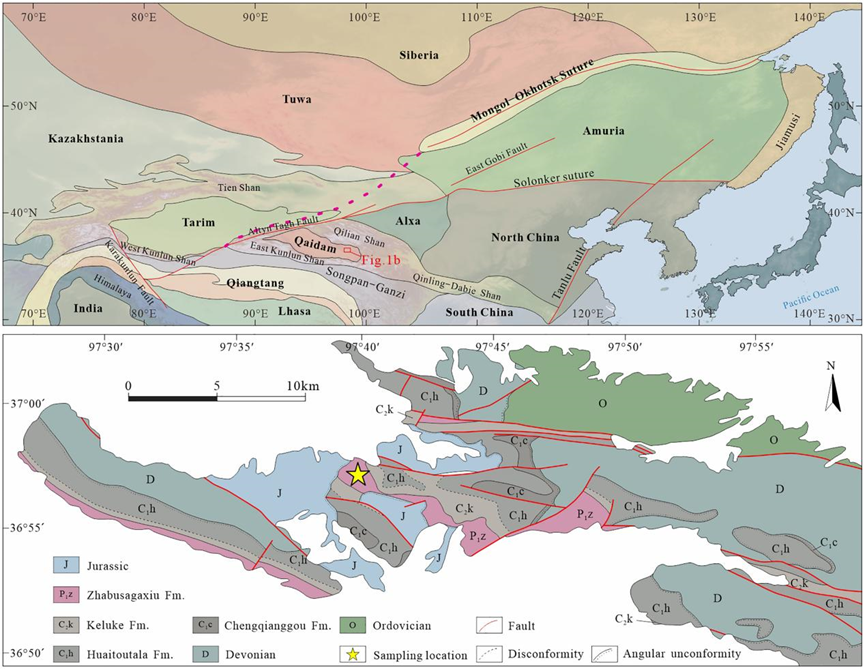
In order to search for this missing structural boundary, the research team conducted paleomagnetic studies on the Lower Permian Zabusagxiu Formation limestone (Figure 1) and the Upper Permian Bayinhe Group red layer in the northern margin of the Qaidam Basin (Wang et al., 2025), and compared the results with high-quality paleomagnetic data published in the region. The results show that during the Permian to Triassic period, the paleolatitude changes of the Qaidam block were basically consistent with those of the North China block, indicating that the two may have belonged to the same continental plate at that time and maintained coordinated movement.
Comprehensive analysis indicates that this concealed suture zone may be connected to the Mongolian Okhotsk suture zone to the northeast and to the suture zone formed by the closure of the ancient Tethys Ocean Basin to the southwest.
. This study provides new clues to reveal the final assembly process of the Eurasian continent.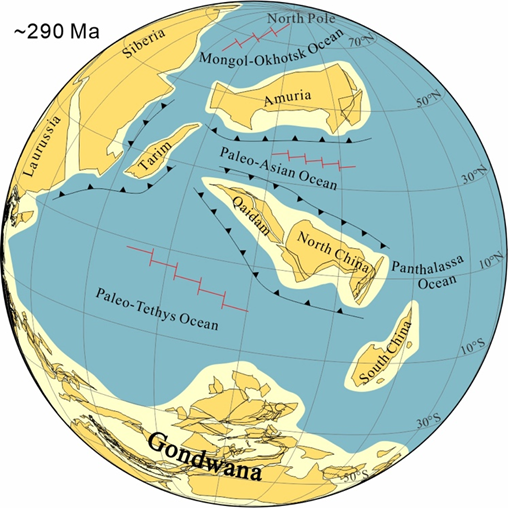
Relevant research results have been published in the international academic journals "Journal of Geophysical Research: Solid Earth" and "Earth and Planetary Science Letters". Our postdoctoral fellow Wang Teng is the first author of the paper, and Associate Professor Zhou Yanan, Professor Dong Yunpeng, and Professor Douwe J.J. van Hinsbergen from Utrecht University in the Netherlands are co corresponding authors.
Paper link:
Wang, T., Zhou, Y., van Hinsbergen, D. J. J., Sun, J., Cheng, X., Chai, R., Xu, S., Wang, P., & Wu, H. (2025). Paleomagnetic evidence for a late Permian Qaidam–North China connection, and the cryptic final Mesozoic intra-Asian suture. Journal of Geophysical Research: Solid Earth, 130, e2025JB031123. https://doi.org/10.1029/2025JB031123
Wang, T., Zhou, Y., van Hinsbergen, D.J.J., Dekkers, M.J., Chen, Z., Chai, R., Zhang, D., Wei, B., Xiong, A., Liu, D., Cheng, X., Wu, H., & Dong, Y. (2026). Was there an ocean between the North China-Qaidam and Tarim blocks connecting the Mongol-Okhotsk and Paleo-Tethys oceans? Earth and Planetary Science Letters, 695, 120357. https://doi.org/10.1016/j.epsl.2026.120357

 1 Xuefu Avenue, Guodu Education Industrial Park, Chang'an District, Xi'an, Shaanxi Province
 710127
 029-88302202
 029-88302202
 geo_office@nwu.edu.cn
 English


 登录
登录


 Home
Home