1. Long term debate on the composition of deep lunar material
Understanding the composition of deep lunar material is the core foundation for constraining the internal structure of the moon and inverting the evolution process of early magmatic oceans.
. Remote sensing observation results show that spectral signals of olivine and low calcium pyroxene are commonly observed around large impact basins on the moon, with low calcium pyroxene signals being the main ones around the South Pole Aiken Basin. This phenomenon has sparked a long-standing controversy in the planetary science community: is olivine or low calcium pyroxene the main mineral in the lunar mantle? Clarifying the origin and material sources of low calcium pyroxene has become a key breakthrough in answering this question.2. Identification of foreign peridotite debris in lunar soil of Chang'e-5
The research team screened and identified a foreign debris with a size of about 50 × 60 microns from the lunar soil sample (CE5Z0403YJFM) of Chang'e-5.
. The rock fragment has a glassy structure and is composed of three parts: olivine (about 29 vol%), pyroxene (about 32 vol%), and feldspar glass substrate (about 39 vol%).Among them, the olivine is high magnesium olivine, with a melted harbor like edge and a clearly developed reverse ring structure (Figure 1): the core is relatively rich in iron, the edge is rich in magnesium, and the Fo value increases from about 90.4 in the core to about 93.4 in the edge, with an average Fo value of about 92.1 in the core.
. Pyroxene is produced in the form of long columnar micron sized aggregates, with dendritic nanocrystals developed at the edges. Electron probe composition analysis shows that it is low calcium pyroxene (En ₅₂ - ₆₄) ₉Fs₂₈. ₈–₃₆. ₇Wo₅. ₃₁–₁₁. (Figure 1). The glass matrix is enriched with Ca and Al, with a ratio of nearly 1:2, and the composition is highly consistent with that of plagioclase.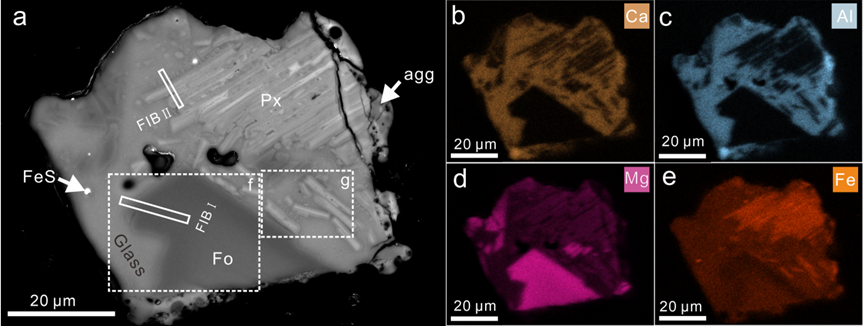
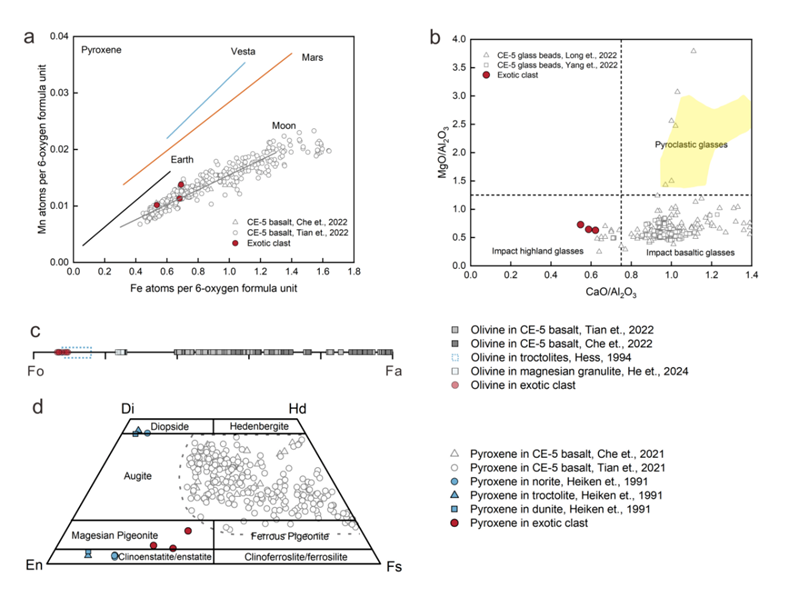
Mineral chemical verification shows that the Fe/Mn ratio of pyroxene falls within the compositional range of Chang'e-5 basalt (Figure 2a), confirming its lunar origin; However, there is a significant difference in the composition of its major elements compared to the pyroxene in the basalt of the Chang'e-5 landing area (Figure 2d), indicating that the debris is not local lunar mare basalt debris, but rather lunar peridotite material transported here by impact sputtering.
By comparing with reported lunar primary peridotite samples, the whole rock chemical characteristics of this rock fragment, which is rich in MgO and FeO and poor in Al ₂ O3 and CaO, are closer to those of the Apollo 14 samples. In the composition diagram of plagioclase An # and olivine Mg #, it belongs to Class I magnesium rich peridotite type (Shervais and McGee, 1999).
.
3. Evidence and Formation Mechanism of Impact Formation of Low Calcium Pyroxene
With the help of Focused Ion Beam Transmission Electron Microscopy (FIB-TEM) technology, the research team further analyzed the microstructure and compositional characteristics of pyroxene: pyroxene has clear compositional zoning, with low Ca and rich Fe in the core, and rich Al and Ca in the edge and dendritic regions. The selected area electron diffraction results confirm that the core of the pyroxene is variable pyroxene (low calcium monoclinic pyroxene), and the edges, dendrites, and young crystals are ordinary pyroxene (Figure 3). Quantitative component analysis shows that the average Ca content in the core of pyroxene is about 0.36 at% (Wo ≈ 3.7), and the Ca content in the edge increases to about 3.84 at% (Wo ≈ 21.5).
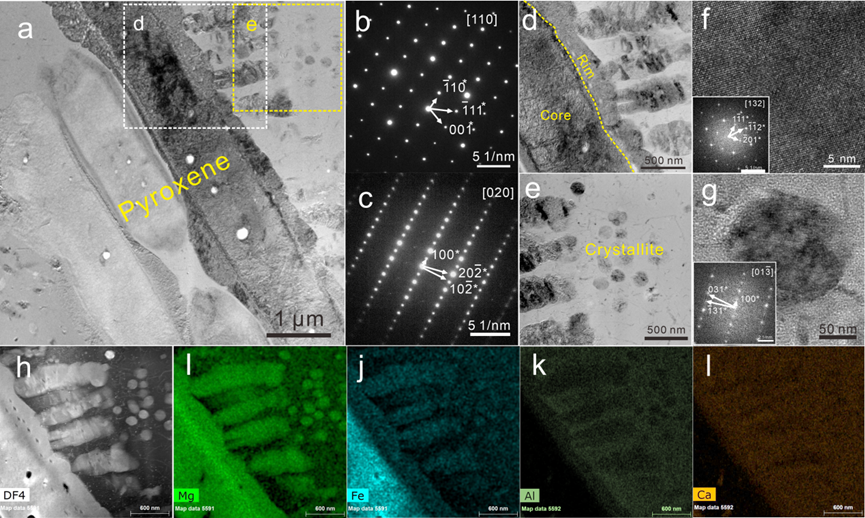
Based on multidimensional observation results, the research team proposes that the low calcium pyroxene is a product of rapid recrystallization of the melt after impact. The core basis includes:
compositional differences: the main elemental composition of pyroxene is significantly different from that of pyroxene in the primary magnesian rock suite;
Structure and morphology: Pyroxene is in the shape of long columns, with a large number of dendritic nanocrystals growing perpendicular to the long axis direction at the edges. This is a typical feature of rapid cooling of the melt and preferential growth along the fastest growth direction. The required cooling rate is much higher than that of volcanic processes inside the moon.
; At the same time, a strong supercooling environment can inhibit olivine nucleation and instead promote low calcium pyroxene nucleation and the formation of dendritic morphology;Crystallization sequence: The core of pyroxene is low calcium variable pyroxene, and the edges, dendrites, and young crystals are high calcium ordinary pyroxene, which conforms to the normal crystallization evolution sequence of pyroxene in silicate melts; The magnesium value of Al rich high calcium pyroxene at the edge is higher than that of low calcium pyroxene at the core, indicating a gradual enrichment of magnesium in the melt, which matches the observed preferential melting of olivine iron rich components induced by impact;
Missing exsolution structure: The primary pyroxene in the magnesian rock suite usually develops exsolution phenomenon, while no such structure was observed in the pyroxene in this rock fragment.
Based on the reverse zoning and erosion edge characteristics of olivine, as well as the presence of plagioclase glass matrix, the research team determined that the rock debris was formed by the rapid cooling and crystallization of peridotite after partial melting due to impact; The calculation of elemental mass balance shows that olivine and plagioclase undergo partial melting and recrystallization, forming a mineral combination of "low calcium pyroxene+aluminum rich high calcium pyroxene". The reaction process can be simplified as: CaAl ₂ Si ₂ O ₈+(Mg, Fe) ₂ SiO ₄=2 (Mg, Fe) SiO I3+CaAl ₂ SiO ₆. The Si element released during the transformation of plagioclase to aluminum rich high calcium pyroxene precisely compensates for the Si consumed in the formation of low calcium pyroxene, so the total content of Si element remains stable throughout the melting recrystallization process.
4. Source and Scientific Significance
The olivine Fo value in this rock fragment is as high as 92.1, and the whole rock MgO content is 25.6 wt%, indicating that its parent rock comes from the lunar crust or even the depth of the lunar mantle.
. Only the impact of large impact basins, such as the Antarctic Aiken Basin and the Mare Imbrium Basin, can penetrate the lunar crust and excavate such deep materials to the lunar surface.Composition comparison shows that the mineral chemical characteristics of the debris are highly similar to those of the Fra Mauro highland samples from Apollo 14, which are widely believed to be ejecta from the Imbrium Basin.
; Based on previous reports on the impact of high Mg # on glass beads in the lunar soil of Chang'e-5, as well as numerical simulations of the transport of ejecta, it is supported that there is distant ejecta from the Yuhai Basin in the lunar soil of Chang'e-5. Meanwhile, remote sensing observation data shows that spectral signals rich in olivine and low calcium pyroxene are widely distributed at the edge of the Yuhai Basin, and low calcium pyroxene anomalies have also been identified in the Mons Heng area of the Chang'e-5 landing zone. Based on the above evidence, the research team speculates that the formation and transport process of the rock debris was initially excavated and uplifted to the surface of the moon by a large-scale impact event in the Yuhai Basin, and then transported to the landing area of Chang'e-5 by another impact in the Hengshan area. Based on the mineralogical observations in this study, a significant portion of the low calcium pyroxene remote sensing signals observed around large impact basins on the Moon may come from materials formed by impact modification of olivine rich rock types (such as peridotite), rather than direct excavation of deep lunar material. This study provides a new research perspective and key evidence for interpreting lunar remote sensing data, constraining the composition of deep lunar material, and understanding the impact modification process of atmospheric free celestial bodies.Author Introduction: Associate Professor Guo Zhuang from the Department of Geology at Northwest University is the corresponding author of the paper, and Dr. Bai Yang, a doctoral student/assistant engineer from the Department of Geology at Northwest University, is the first author. The National Key Laboratory of Continental Evolution and Early Life in the Department of Geology at Northwestern University and the Joint Center for Earth and Planetary Sciences at Northwestern University and the University of Hong Kong are the first units for the paper. Other co authors include Qian Yuqi from the University of Hong Kong, Charles K. Shearer from the University of New Mexico, Shichuan Sun and Simon A.T. Redfern from Nanyang Technological University, Huang Kangjun, Chen Lihui, Dong Yunpeng from Northwestern University, and Academician Zhao Guochun from Northwestern University/University of Hong Kong. This research is supported by the National Natural Science Foundation of China.
Article information: Bai, Y., Guo, Z., Qian, Y., Sun, S., Ma, J., Huang, K., Chen, L-H., Dong, Y., Redfern, S.A.T., Shearer, C.K., Zhao, G., Impact-induced formation of low-Ca pyroxene in a partially melted troctolitic clast from the Chang’e-5 lunar regolith, Geochimica et Cosmochimica Acta (2026)
https://doi.org/10.1016/j.gca.2026.09.038

 1 Xuefu Avenue, Guodu Education Industrial Park, Chang'an District, Xi'an, Shaanxi Province
 710127
 029-88302202
 029-88302202
 geo_office@nwu.edu.cn

 English


 登录


 Home