Focusing on this problem, our doctoral student Zhang Dongmeng, under the joint guidance of Professor Cheng Xin and Professor Vadim A. Kravchinsky, relying on the Paleomagnetism Laboratory of Northwest University and the National Key Laboratory of Continental Evolution and Early Life, and in conjunction with the Institute of Geology and Geophysics of the Chinese Academy of Sciences, the University of Alberta, Yan'an University, Laoshan Laboratory and other units, selected early Cambrian clastic rock profiles from multiple profiles in eastern Yunnan to carry out paleomagnetic research (Figure 1), and carried out systematic thermal demagnetization, alternating demagnetization, and rock magnetism on 360 directional samples from five profiles and scanning electron microscope energy spectrum analysis.
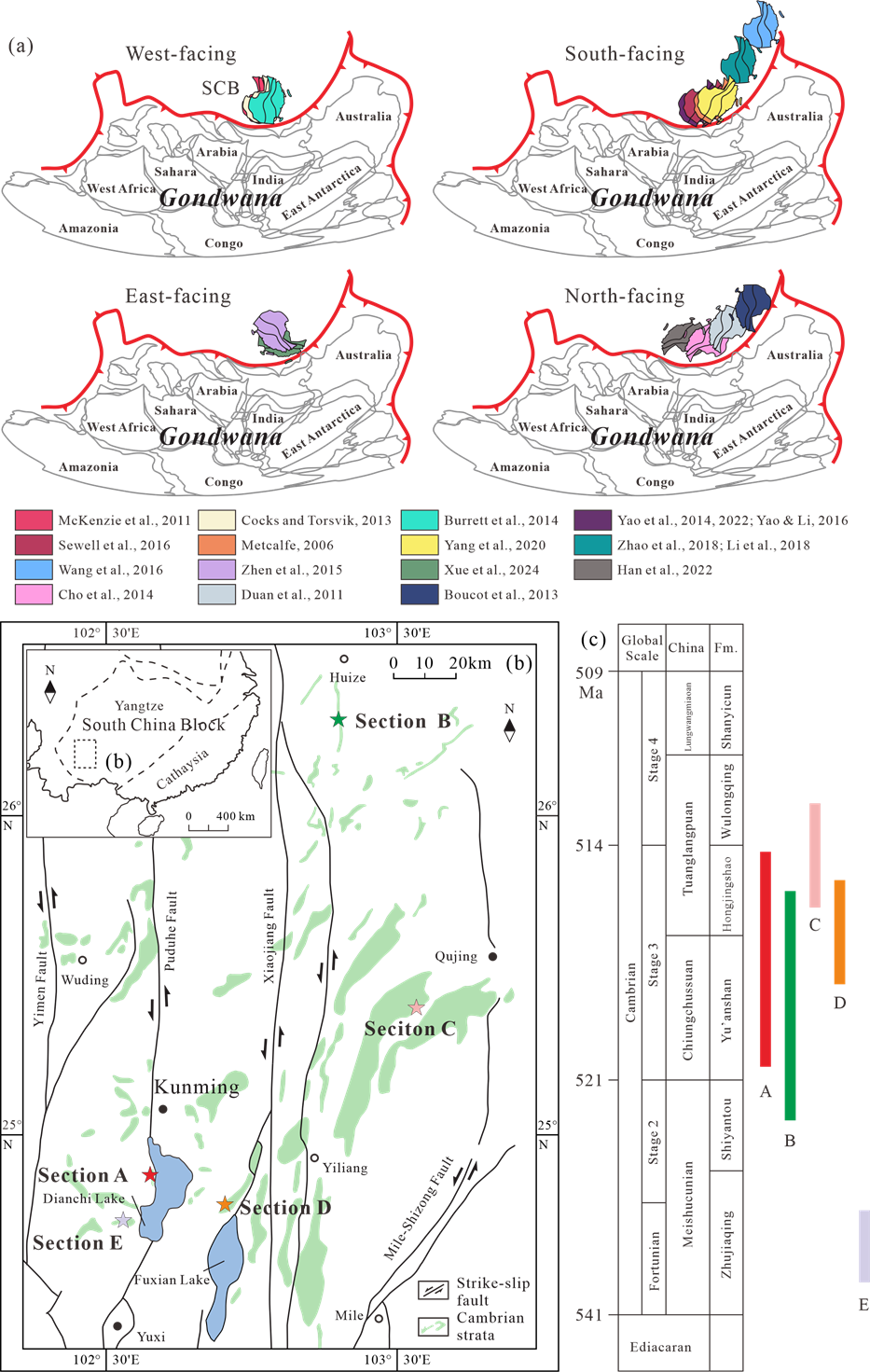
In the Cambrian third stage detrital sedimentary rocks of the Gulian Village section (section A), a characteristic remanence with magnetite as the main magnetic carrier mineral and positive and negative polarities was studied, and a new paleomagnetic pole GY (∧ p=− -69.0 ° N, Φ p=163.6 ° E, A95=3.2 °) was determined, N=29)。 Although the folds in the study area may have formed during the Cenozoic era, rock magnetic analysis, active inversion testing, and comparisons with other young paleomagnetic poles in southern China all support the residual magnetism of the Gulian Village profile as a primary cause. SVEI analysis also indicates that the shallowing effect of dip angle is minimal, further supporting the reliability of paleolatitude estimation. Considering that the Sichuan Yunnan region has undergone a clockwise vertical axis rotation of about 20 ° relative to the Eurasian continent since the Oligocene Miocene, further research has obtained a rotation corrected paleomagnetic pole GY '(∧ p=-51.8 ° N, Φ p=182.8 ° E, A95=3.2 °). Based on this, the South China Block was located in a low latitude region of the southern hemisphere (13.6 ° S ± 3.2 °) and a southwest orientation (Ds=-141.2 °) around 518 Ma. In contrast, other profiles did not obtain stable records of bipolarity, and their paleomagnetic poles were close to the location of the Cretaceous Cenozoic paleomagnetic poles in the region, indicating that these profiles may have been influenced by Cenozoic magnetization and highlighting the unique value of paleomagnetic records in the Gulian Village profile.
Based on the comparison and fitting of the apparent pole shift curve, the study further indicates that the South China block had similar kinematic processes to the East Gondwana during approximately 520-405 Ma.
. After paleogeographic reconstruction in the Australian reference coordinate system, the southwestern edge of the South China block is located near the India Australia junction, facing north India and northwest Australia (Figure 2). This reconstruction result is consistent with the paleobiogeographic evidence of the early Cambrian and is supported by detrital zircon source records. Overall, research suggests that the South China Block maintained close paleogeographic connections with the East Gondwana during the third Cambrian period, and this connection may have continued into the Early Devonian. This achievement provides new quantitative constraints for understanding the early Paleozoic paleogeographic pattern around the Gondwana continent, the early evolution of the Proto Tethys Ocean, and the geographical background of Cambrian biogenic radiation.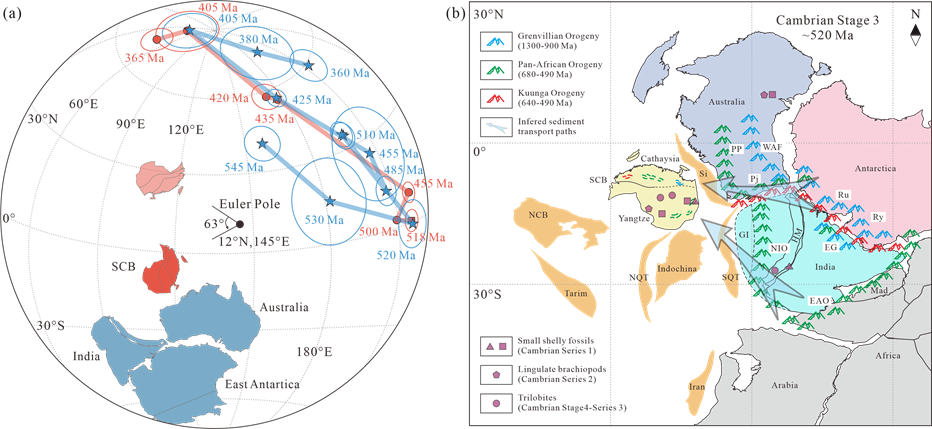
This achievement is titled "Cambrian Stage 3 paleomagnetism of the South China Block: Implications for Early Paleozoic Gondwana reconstructions". Zhang Dongmeng, a PhD student in the Department of Geology, is the first author of the article, and Professor Cheng Xin and Professor Vadim A. Kravchinsky are co corresponding authors. The research was jointly funded by the National Key Research and Development Program (2025YFF0811701), the National Natural Science Foundation of China (42274097, 42674086, 42304092, 42504059), and the Natural Science and Engineering Research Council of Canada (RGPIN-2024-05918).
Zhang, D., Cheng, X., Kravchinsky, V. A., Zhong, M., Wei, B., Jiang, N., et al. (2026). Cambrian Stage 3 paleomagnetism of the South China Block: Implications for Early Paleozoic Gondwana reconstructions. Journal of Geophysical Research: Solid Earth, 131, e2026JB035049. https://doi.org/10.1029/2026JB035049

 1 Xuefu Avenue, Guodu Education Industrial Park, Chang'an District, Xi'an, Shaanxi Province
 710127
 029-88302202
 029-88302202
 geo_office@nwu.edu.cn

 English


 登录


 Home