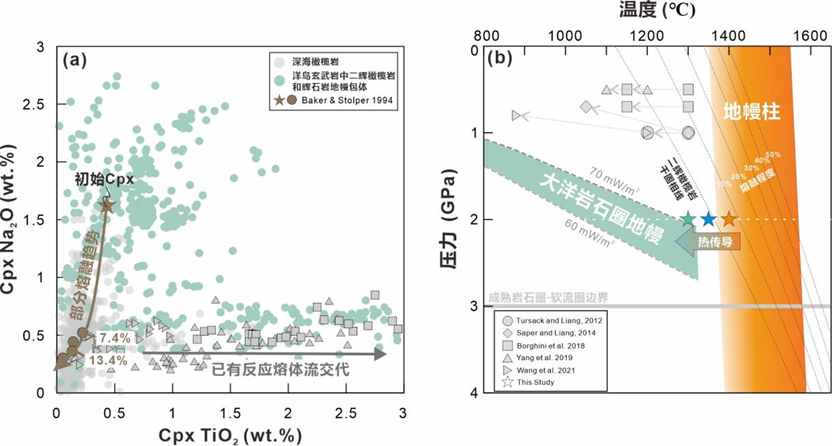
Based on the above questions and speculations, the research team systematically conducted reactions and in-situ crystallization experiments between eclogite/rich siliceous pyroxene melts and amphibolite under high pressure conditions of 2 GPa. The experimental variables include different cooling amplitudes (1400 ℃ → 1350 ℃ → 1300 ℃), melt/rock ratios (1:2, 1:1, 2:1), and reaction times (4-48 hours). The aim is to simulate the interaction between mantle plumes and oceanic lithospheric mantle (OLM), systematically explore the effects of temperature, melt flux, and melt migration velocity on metasomatic reactions, and resolve the controversy over the causes of OLM heterogeneity; And based on experimental products, constrain the evolution process of OLM physical properties, and then construct corresponding lithospheric dynamics evolution models. The main insights gained from the study are as follows:
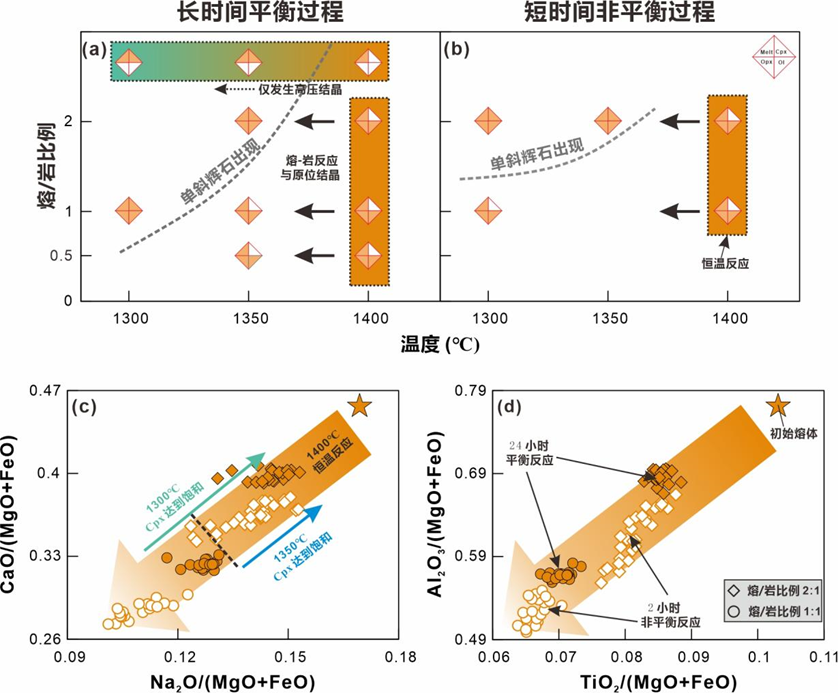
(1) Multiple factors controlling the genesis of clinopyroxene and clinopyroxene have been revealed: during the interaction between the silicon rich reaction melt flow and harzburgite, olivine is dissolved and clinopyroxene ± clinopyroxene is precipitated/crystallized. Monoclinopyroxene crystallizes only under high melt to rock ratio, long reaction time, and low temperature conditions, while clinopyroxene crystallizes under opposite conditions (Figure 2a-b). The differences in the above crystal types are attributed to the dynamic evolution of the melt composition during the interaction between the melt and peridotite - the melt generated by high melt/rock ratio, long reaction time, and low temperature is more enriched in elements such as Ca, Na, Al, Ti, which is conducive to the saturation of clinopyroxene (Figure 2c-d).
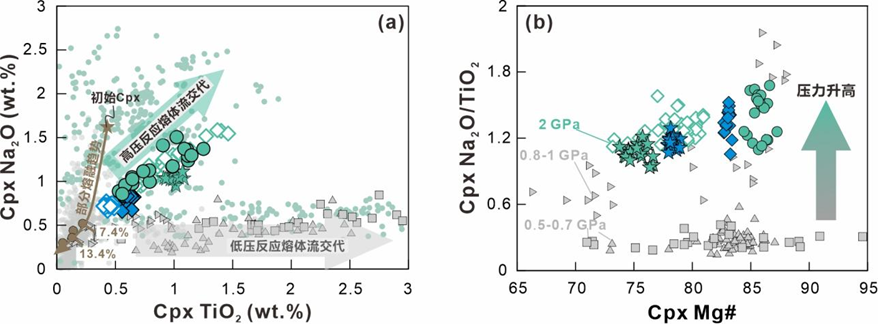
(2) It has been confirmed that high-pressure reaction melt flow plays a key role in OLM metasomatism: monoclinic pyroxene formed under 2 GPa conditions exhibits synchronous enrichment of Na and Ti, explaining the origin of Na - and Ti rich monoclinic pyroxene in natural samples (Figure 3a). Meanwhile, the Na/Ti ratio can effectively distinguish the formation pressure of clinopyroxene - high Na/Ti indicates high pressure, while low Na/Ti indicates low pressure (Figure 3b).
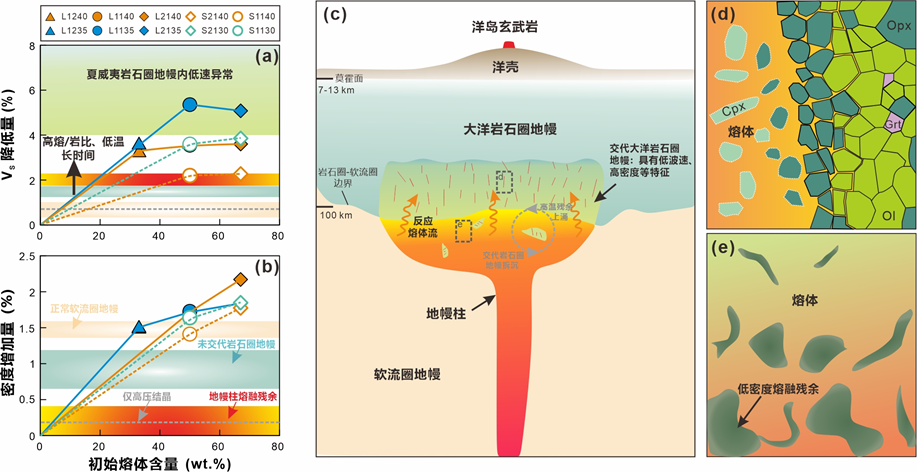
(3) characterizes the dynamic evolution process of physical properties of OLM under mantle plume background: when the mantle plume interacts with OLM, the high-temperature reactive melt flow reshapes the mineral composition of OLM through element diffusion and mineral crystallization, thereby changing its overall physical properties. This not only leads to a significant decrease in the seismic wave velocity of the explained OLM (explaining the shallow low velocity anomaly of mature OLM), but also increases its density and causes subsidence; After dismantling, the residual melting of the low-density mantle plume below upwelling, forming local vertical convection, driving the dynamic evolution of the physical and chemical properties of the OLM (Figure 4).
Paper information: Hou, Y.S. (Hou Yongsheng), Li, H. Y. * (Li Hongyan), Zhang, C. * (Zhang Chao), Wang, Y. (Wang Yu),& Xu, Y. G. (2026). Transformation of Refractory Oceanic Lithospheric Mantle by Reactive Melt Infiltration: An Experimental Study on the Roles of Temperature, Melt Volume, and Ascent Velocity. Journal of Geophysical Research: Solid Earth, 131, e2026JB033875 https://doi.org/10.1029/2026JB033875

 No. 229, Taibai North Road, Xi'an, Shaanxi Province
 710069
 029-88302202
 029-88302202
 geo_office@nwu.edu.cn
 English


 登录
登录


 Home
Home