Recently, the Joint Center for Earth and Planetary Sciences of Northwestern University Hong Kong University, the National Key Laboratory for Continental Evolution and Early Life of the Department of Geology of Northwestern University, together with the Institute of Geochemistry of the Chinese Academy of Sciences, made progress in the study of lunar soil samples on Chang'e-6. The research team used the Automatic Mineral Analyzer (TIMA) to conduct systematic screening on tens of thousands of lunar soil samples from Chang'e-6, identifying particles with significant copper rich characteristics. By combining transmission electron microscopy (TEM) and electron energy loss spectroscopy (EELS) analysis, it was revealed that the Fe-Cu-S system formed a symbiotic mineral combination of metallic copper, metallic iron, and bornite (Cu ₅ FeS ₄) under the high-temperature environment of lunar surface impact, and relevant evidence of the synergistic evolution of iron and copper valence states was obtained. Related achievements are presented in “Impact-induced high-temperature formation of metallic copper and bornite in Chang’e-6 lunar soils” Title: Published in the international academic journal "npj Space Exploration". This study provides important evidence for a deeper understanding of the migration and enrichment process of copper elements driven by surface impacts on non atmospheric celestial bodies, as well as the valence state coupling mechanism of copper iron elements. Understanding the migration and enrichment mechanisms of metal elements on the surface of non atmospheric celestial bodies is of great significance for the efficient development and utilization of extraterrestrial resources. Asteroids are widely regarded as key targets for future utilization of extraterrestrial resources, but currently the number of asteroid samples available for research is extremely limited. The moon and asteroids are both atmospheric bodies with similar environments of high vacuum, low gravity, and frequent impacts. Therefore, studying the chemical behavior of metal elements driven by impacts in lunar material can provide a fundamental understanding of the migration and enrichment mechanisms of metal elements on the surface of atmospheric free celestial bodies in the solar system. Copper, as a moderately volatile element and an important industrial metal, is widely present in asteroid samples. About 66% of ordinary chondrites have been observed to contain copper metal phases, and there have also been reports of copper minerals in the samples returned by Itokawa asteroid. Compared to that, only a small amount of copper minerals were found in the lunar samples. The Chang'e-6 mission has returned samples for the first time from the Aiken Basin in the South Pole of the far side of the Moon, which has a complex impact geological background. It is an ideal object for studying the chemical behavior of copper elements driven by lunar surface impacts.
Copper rich particles in lunar soil of Chang'e-6
The research team used an automatic mineral analyzer (TIMA) to systematically screen tens of thousands of fine-grained lunar soil powders of Chang'e-6 and successfully identified a copper rich particle with a diameter of about 15 microns.
. The copper rich particles adhere to the surface of the cement, with a chemical composition mainly composed of iron, sulfur, and copper, and do not contain nickel elements (Figure 1). The transmission electron microscopy (TEM) analysis of focused ion beam (FIB) slices showed that the copper rich sulfide phase inside the particles coexisted with pure metallic iron particles (Fe ⁰) and apatite, indicating their lunar endogenous source. In addition, the accompanying metallic iron particles exhibit harbor like boundaries of local erosion, and iron sulfide veins are observed to penetrate the interior of apatite (Figure 2). These microstructural features collectively indicate that the copper rich particles have undergone significant impact melting transformation.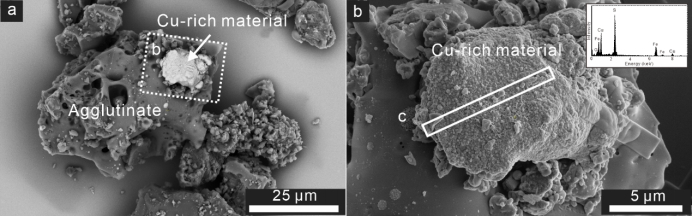
Internal microscopic mineral characteristics of copper rich particles
TEM analysis results further show that the interior of copper rich sulfides can be divided into three areas with significant differences in microscopic mineral characteristics, namely the Cu ⁰ - rich zone, the Cu ⁰ - free zone, and the surface iron copper sulfide coating (Figure 2b).
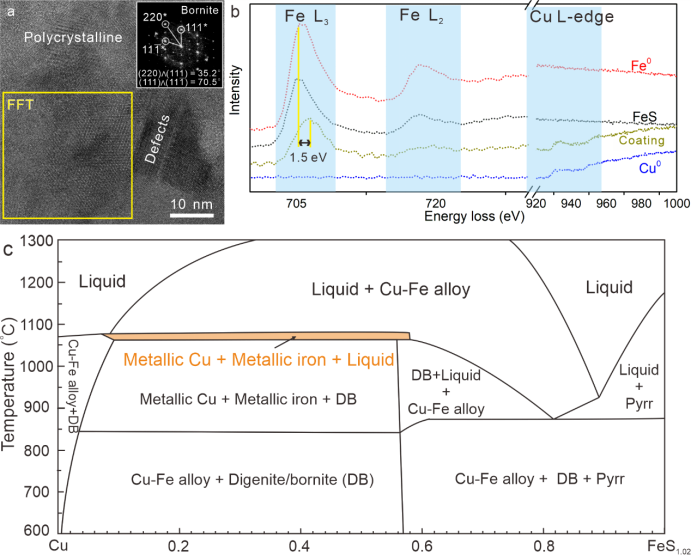
. Among them, the matrix of the copper rich region and the copper free region are mainly composed of iron sulfides, but there are differences in the microscopic mineral composition inside the two regions: the copper rich region contains a large number of submicron sized copper and iron particles; The area without metallic copper mainly contains metallic iron particles and exhibits obvious pore structures. The thickness of the surface iron copper sulfide cover layer is uniform, about 200 nanometers, and its chemical composition is mainly composed of copper, iron, and sulfur elements (different from the blue chalcopyrite found in the lunar soil of Chang'e-5). In addition, the iron copper sulfide cap layer exhibits a polycrystalline morphology, and the results of structural and elemental valence state measurements indicate that it is mainly composed of bornite (Cu ₅ FeS ₄), with the valence state of iron mainly being Fe ³ ⁺ (Figure 3).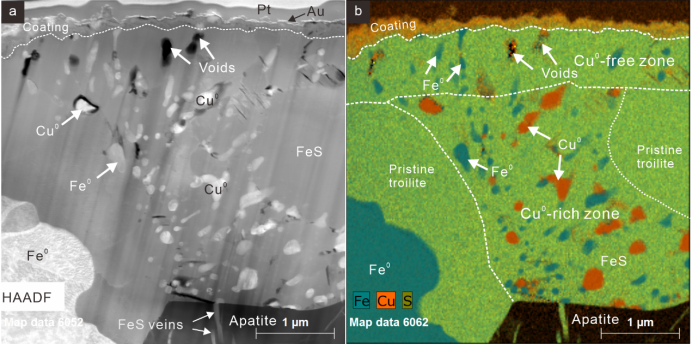
Impact high-temperature genesis mechanism
The submicron level metallic copper in the Cu ⁰ - rich zone is located inside the particles (up to 4 microns deep) and coexists with metallic iron, exhibiting an overall melting characteristic. These observations indicate that the metallic iron and metallic copper embedded in the copper rich particles of Chang'e-6 originate from the crystallization process of the melt, rather than being formed through steam deposition. According to thermodynamic models and the iron copper sulfur phase diagram, under high temperature conditions, metallic copper and metallic iron have a wide range of equilibrium stability in the iron copper sulfur system (Figure 3). Therefore, the metal rich copper region observed in the sample is the product of cooling crystallization of high-temperature copper rich melt.
The mineral composition of the sub surface copper free area is significantly different from that of the lower metal rich copper area, mainly characterized by the presence of metallic iron and pore structures. Previous research has shown that under vacuum and high temperature conditions, lunar surface iron sulfides are highly susceptible to desulfurization reactions. Therefore, the metallic iron and pores in the copper free region are attributed to the thermal desulfurization reaction on the surface of lunar soil iron sulfides under high temperature conditions. In addition, the uniform distribution characteristics of the iron copper sulfide cover layer, and its significant compositional differences from the underlying copper free areas, indicate that the iron copper sulfide cover layer containing bornite mainly originates from the process of evaporation deposition, which is consistent with the volatility of copper and sulfur elements.
In summary, this study found the presence of metallic copper and Fe ³ ⁺ bornite in the lunar soil of Chang'e-6, indicating that the high-temperature melting and gasification processes induced by lunar impacts can promote the reduction, migration, and enrichment of copper elements on the lunar surface. Based on previous observations of meteorites, metal and sulfide phases are the main carriers of copper in planetary materials. It is worth noting that the high-temperature gasification process on the lunar surface usually creates a reducing environment. The presence of Fe ³ ⁺ bornite sedimentary layers in lunar soil indicates that under the high-temperature conditions induced by lunar impact, the Fe-Cu-S system exhibits complex valence state coupling effects of iron and copper elements.
About the author: Associate Professor Guo Zhuang of the Department of Geology of Northwest University is the first author and corresponding author of the paper, and researcher Li Yang of the Institute of Geochemistry of the Chinese Academy of Sciences is the co corresponding author of the paper. The National Key Laboratory of Continental Evolution and Early Life in the Department of Geology at Northwestern University and the Joint Center for Earth and Planetary Sciences at Northwestern University and the University of Hong Kong are the first units for the paper. Other co authors include Professor Song Dongsheng from Anhui University, Professor Song Wenlei from Northwestern University, Professor Huang Kangjun, and Academician Zhao Guochun from Northwestern University/University of Hong Kong. This research has received support from multiple projects, including the National Natural Science Foundation of China and the Hong Kong Research Grants Council.
Article information:
Guo, Z., Song, D., Song, W. et al. Impact-induced high-temperature formation of metallic copper and bornite in Chang’e-6 lunar soils. npj Space Exploration. 2, 13 (2026). https://doi.org/10.1038/s44453-026-00027-y

 No. 229, Taibai North Road, Xi'an, Shaanxi Province
 710069
 029-88302202
 029-88302202
 geo_office@nwu.edu.cn
 English


 登录
登录


 Home
Home